


Welcome back to the George W. Bush Institute’s education newsletter, where we explore how evidence-based literacy policy, aligned assessments, and accountability systems work together to raise expectations and improve outcomes across K-12 education. This month, we look at what it takes to move good policy into classrooms – from extending reading supports for adolescent learners to using better data to identify students who need interventions earlier. We also examine how states are responding to new challenges around AI, technology, and school choice while keeping student outcomes at the center.
If you’re new to the Bush Institute, welcome. We are a nonpartisan organization committed to promoting freedom, opportunity, accountability, and compassion. If this newsletter was forwarded to you and you’d like to receive future editions, reply to this email, and we’d be glad to add you to our list.
Thank you for reading.
Monthly snapshot
40% of students in grades 3-8 struggle to decode grade-level texts
In most schools, foundational literacy instruction is concentrated in kindergarten through third grade. After that, students are expected to “read to learn,” even if they have not yet mastered the decoding skills required to do so. As a result, many students encounter increasing difficulty as texts become more complex in upper elementary and middle school.
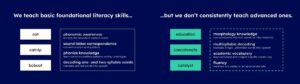
A five-year study from Reading Reimagined finds that many older students can decode simple words but struggle with the multisyllabic words that become common in upper grades. Those gaps can stall fluency and comprehension. Reading Reimagined calls for foundational literacy instruction to continue through eighth grade, with explicit teaching of advanced decoding, morphology, vocabulary, sentence structure, and fluency.
This past month, Rebecca Kockler, founder of Magpie Literacy and chief learning and product officer at Great Minds, shared insights from her research with state leaders about why adolescent literacy is a critical component of a comprehensive state reading strategy and how states should approach this work. Kockler calls on states to build coherent systems that put high-quality materials, better diagnostics, explicit instruction, and strong implementation support in teachers’ hands.
State spotlight
In Arkansas, policy coherence leads to rising achievement
Arkansas’s latest results on its statewide assessment, ATLAS, show gains across every major subject since 2024. Math proficiency rose to 44.2% from 36.4%, science to 44.0% from 35.6%, and English-language arts to 39.5% from 33.8%. Third-grade reading also climbed to 43% from 35%.
The gains come as Arkansas continues implementing the 2023 LEARNS Act, which requires teacher training in the science of reading and explicitly mandates literacy interventions that extend all the way through grade 12. The state’s K-3 ATLAS assessment measures foundational skills such as phonemic awareness, decoding, encoding, oral reading fluency, language comprehension, vocabulary, and reading comprehension, giving educators more specific information about where students are succeeding or struggling.
Bush Institute insights
- Anne Wicks, the Don Evans Family Managing Director at the Bush Institute, joined hosts Shaka Mitchell and Caitlin Sienkiewicz on the Quality Matters Podcast to discuss the purpose of American education and the power of state leaders to improve outcomes for young people.
- U.S. reading scores for 15-year-olds fell 14 points on the 2025 Program for International Student Assessment (PISA), an international assessment administered every three years to 15-year-olds in 91 countries. The PISA measures how well students can apply reading, math, and science knowledge and skills to real-world problems. These latest scores are at their lowest level in nearly 25 years, behind several high-performing Asian and European countries, and reflect what the National Assessment of Educational Progress has already told us – U.S. reading achievement has declined significantly, particularly among lower-performing students.
- In a piece for the Bush Center website, Will Cullen and I argue that the path forward is clear: States should stay focused on implementing science-of-reading reforms through stronger teacher preparation, high-quality professional development and instructional materials, and early screening and intervention. With 44 states having adopted science-of-reading policies, the challenge now is sustained implementation that translates those reforms into better outcomes for students.
Science of reading
- As Ohio prepares for a new governor in 2027, Gov. Mike DeWine is using his platform to urge his successor and state leaders to continue supporting the state’s bipartisan science-of-reading reforms. Since 2024, Ohio schools have been required to use evidence-based reading instruction, and the state has expanded support through additional reading coaches, educator preparation reforms, and other literacy investments. Early results are encouraging, but sustained funding and strong implementation will be critical to achieving the reforms’ full impact. “We have an obligation to do everything we can so that a child can live up to his or her God-given potential,” DeWine said in an interview.
- In an op-ed for the Wall Street Journal, Rachel Canter argues that any state can replicate Mississippi’s gains in reading, regardless of political contexts, as long as the state pairs strong policy with sustained implementation. She notes that strong unions can make reform more difficult, but not impossible. Canter points to New Mexico, Maryland, and Massachusetts as examples of states that recently advanced evidence-based literacy reforms despite political or union opposition, often through broad coalitions, gubernatorial support, and teacher advocacy.
- A new article in The 74 argues that lasting reading reform requires more than passing laws; states and districts must equip everyone responsible for implementation with the knowledge, tools, and support to succeed. Casey Taylor of ExcelinEd highlights North Carolina’s systemwide approach by training teachers, instructional support staff, and school leaders in the science of reading and building a layered coaching model that connects state, regional, district, and school-level support. The goal is to ensure that responsibility for stronger reading instruction is shared across the system, not left to classroom teachers alone.
Measurement matters
- NWEA, a national assessment provider, shared research from June that shows students who remain in the bottom 20% of math achievement through first grade rarely reach proficiency by third grade. That suggests third grade – the point when statewide testing typically begins – may be too late to identify students who are already falling behind. In response to the findings, the Fordham Institute argues that states policies to screen in kindergarten and first grade can give schools and families valuable information, but only if systems are in place to act on it. Policymakers focused on third-grade proficiency should pair early screening with targeted intervention as the starting point for a coordinated, multiyear response.
- Ohio is tightening which industry credentials count toward high school graduation after concerns that students were earning easy certificates with little value in the labor market. The state cut its list of qualifying standalone credentials from 164 to 70 and reduced lower-level credentials from more than 700 to 126, organized by career pathway. The changes are intended to better align graduation requirements with employer demand, wages, job growth, and opportunities for further education. State officials acknowledge the shift could lower graduation rates but argue that credentials should signal real skills that lead to meaningful employment rather than functioning as a shortcut to a diploma.
- The U.S. Department of Education announced that Arizona, Nevada, and South Carolina have been approved for Ed-Flex authority, bringing the total number of participating states to 25. Ed-Flex allows states to waive certain federal requirements and give districts greater flexibility over some federal education funds. Supporters argue that greater state and local control can help leaders respond more effectively to student needs and reduce unnecessary administrative burdens. Critics, while not generally opposed to flexibility, question whether greater discretion will be matched by the transparency, accountability, and oversight needed to ensure federal dollars reach the students they were intended to support, and, importantly, that student outcomes improve.
- The Bush Institute recently published a Two-Minute Take on Texas’ 2026 school and district report cards. Among the results, the Houston Independent School District stood out for its significant improvement under state-appointed leader, Superintendent Mike Miles. In Miles’ new book, By Design: How to Transform School Systems, he draws on HISD’s overhaul to argue that lasting improvement requires redesigning the system itself. Miles points to clear accountability, coherent structures, strong implementation, and difficult leadership decisions as essential to producing better student outcomes.
ICYMI
- Technology and AI:
- A new tool from Instruction Partners, AI in Action Learning Tour, examines 20 AI products used across more than a thousand school systems to help educators make more informed decisions about classroom use. The resource includes product profiles, lessons learned across tools, and guidance on the benefits and risks of AI in math and literacy instruction. It also offers practical steps for school leaders to encourage helpful uses of AI, limit harmful ones, and communicate clearly with educators and families.
- In a new report from the Fordham Institute, “High Tech, Low Standards: High School in the Age of Distraction,” Brian Fitzpatrick found that daily distractions, heavy screen use, AI, and loose grading practices are making it easier for students to disengage from schoolwork. Sixty-two percent of students said they spend more than half of class time on school-issued devices, often for nonschool purposes. Many students also said they use AI to avoid doing assigned reading, writing, or math themselves, even while reporting earning mostly A’s. The report argues that schools should limit unnecessary device use, set clearer rules for AI, and make sure grades and assessments reflect what students actually know and can do.
- School Choice:
- In an op-ed for the Houston Chronicle, former Florida Gov. Jeb Bush argues that Texas’ new Education Freedom Account program starts with several design features that Florida took years to develop, particularly its universal structure, transparency, and additional funding for students with disabilities. He points to Florida’s experience to argue that school-choice programs improve over time as families use them, providers enter the market, and policymakers adjust rules based on what is working.
- Texas’ new Education Freedom Accounts have given families of students with disabilities access to schooling options that once felt out of reach, The Dallas Morning News reports. Families are now navigating limited private-school capacity, tuition costs that can exceed their awards, and other practical barriers. To meet the needs of students with disabilities, expanding school choice is only part of the equation.


