To celebrate America’s 250th birthday, I will publish a series of 12 essays exploring milestone events that shaped the American economy into what it is today – from the adoption of the Declaration of Independence to the Marshall Plan. I’ll pay particular attention to the country’s formative decades and tell the stories of ideas, policies, and innovations that helped build the world’s strongest economy.
As America’s 74 million kindergarten-through-graduate school students settle into summer break, it’s a good moment to reflect on the central role of education as a pillar of the nation’s modern-day prosperity.
One of the chief reasons the United States enjoys a commanding edge over other countries in income levels and material well-being is that the American people have benefited from far higher educational attainment rates than peers elsewhere for most of the last 250 years. A key milestone in the emergence of this vital advantage was the Morrill Land-Grant College Act of 1862.
Under the Morrill Act, the federal government made large land grants to every state to support the establishment or expansion of colleges focused primarily on agriculture and mechanical arts – an idea without precedent in the world at that time.
The legislation led to a vast expansion of college going and educational attainment across the United States. It democratized America’s higher education sector as well, by creating colleges that welcomed young people from farming and working-class families, taught practical skills beyond what students could learn in high school, and spread new technologies to surrounding farms and businesses.
The idea of federal investment in postsecondary education first arose with the nation’s founders. President George Washington called for a national public university as well as a military academy and small agriculture-focused colleges in several of his addresses to Congress. Alexander Hamilton, America’s first Treasury secretary, supported using federal funds to establish colleges across the country. Benjamin Franklin and Thomas Jefferson played pivotal roles in establishing the University of Pennsylvania and the University of Virginia, respectively.
Later, civil rights leaders Frederick Douglass in the 19th century and Mary McLeod Bethune in the early 20th emerged as leading voices for education – and particularly for going to college – as vital engines of empowerment for Black Americans.
America’s founders also introduced the strategy of deploying the federal government’s tremendous land holdings to support education. Under the Northwest Ordinance of 1787, the Continental Congress provided for land grants to create elementary and secondary schools in cities and towns across the territories west of the Appalachians.
Higher education before the Civil War
Despite the founders’ enthusiasm for higher education, America’s colleges mostly remained small institutions preparing a narrow elite for a handful of high-status occupations from the nation’s founding to the eve of the Civil War.
Harvard University, Yale University, and Princeton University, founded primarily to educate young men for religious ministry, together had enrollment of about 1,700 students in 1860. The United States had just over 375 colleges in all in 1860, but most were very small and primarily served well-off students from their immediate surrounding area, authors Arthur Levine and Scott van Pelt recount in their book The Great Upheaval: Higher Education’s Past, Present, and Uncertain Future. Total enrollment in 1860 amounted to between 1% and 2% of college-age Americans, based on Department of Education data.
Most colleges of the time dedicated little attention to science or “practical” subjects like agriculture or engineering. Almost all institutions instead offered a “classical” curriculum centered on Greek, Latin, philosophy, and literature, following the guidance of an influential report published by Yale’s faculty in 1828.
Social views on education evolved significantly over the next three decades, with considerable differences across regions. In the Northeast, home to America’s most prominent colleges, a growing movement called for modernizing educational institutions and expanding access. Horace Mann, who also served in the Massachusetts legislature and the U.S. House of Representatives, led efforts to build a universal K-12 public school system in his state. Other Northeastern states soon followed. Catharine Beecher, who lived most of her life in New York and Connecticut, founded several colleges for women between the 1820s and the Civil War.
Midwestern states led the nation in establishing state flagship universities in the first half of the 19th century, including the University of Michigan (1817), Indiana University (1820), and the University of Iowa (1847). They also launched several small but high-quality religious colleges: Kenyon College (1824), Denison University (1831), and Oberlin College (1833) in Ohio; DePauw University (1837) and the University of Notre Dame (1942) in Indiana; Northwestern University in Illinois (1851); and Washington University (1853) in Missouri.
Northern advocates for expanding college access cited not just democratic principles but also economic imperatives. The North’s economy rapidly industrialized between the 1830s and 1860s, hugely boosting the demand for skilled industrial workers. Infrastructure projects of unprecedented scale – mostly focused on canals and railroads – required trained engineers and mechanics. The period also saw numerous inventions that gave rise to transformative industries needing skilled workers, like Samuel F.B. Morse’s telegraph (invented in 1837), Isaac Singer’s sewing machine, (1851), and Linus Yale’s cylinder lock (1861).
Breakthrough innovations in agriculture likewise created powerful incentives for up-and-coming farmers to become more highly educated than their parents had been. Key inventions included the McCormick mechanical reaper (invented in 1834), John Deere’s steel plow (1837), grain elevators (1842), and self-governing windmills (1854).
In the South, by contrast, the region’s ruling plantation oligarchs generally chose to educate their children at home with private tutors and opposed broadening college access. Elite Southerners sent to northern colleges – like South Carolina’s renowned political leader John C. Calhoun, who attended Yale – were rare. The Virginia legislature rejected then-Governor Thomas Jefferson’s proposal for broader elementary education in 1779 as well as his proposals to expand access to the University of Virginia in the 1810s. College enrollment among White Southerners badly lagged New England’s levels, while most forms of education for Black people were prohibited by law.
Justin Morrill and the idea of expanding college access
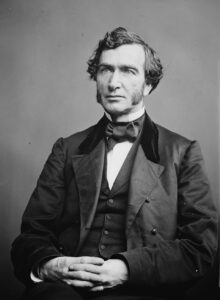
Vermont Congressman Justin Morrill launched the first initiative to provide federal support for higher education with an 1857 bill similar to the one which passed five years later. Morrill, a self-educated businessman with extensive holdings in retail, real estate, and banking, strongly believed college should be “accessible to all, but especially to the sons of toil.”
Morrill came to Congress as a Whig in 1855 and helped found the Republican Party. During his extraordinary 43-year career in the House of Representatives and then the Senate, he helped draft the 14th Amendment to the U.S. Constitution, extending rights granted by the Bill of Rights to formerly enslaved people and requiring states to respect these rights. He also led a successful campaign to create the U.S. Capitol’s popular National Statuary Hall.
Congress approved Morrill’s college bill in 1859. However, President James Buchanan – a Pennsylvanian but also a close ally of Southern plantation oligarchs – vetoed it, arguing that the Constitution did not permit any federal role in education. Buchanan was acting at the behest of his Southern allies, who opposed any expansion of federal authority for fear that an empowered federal government might later turn against the institution of slavery and were in any case uninterested in widening educational opportunities.
A handful of states acted before the federal government to establish public colleges focused on agriculture and mechanical skills and welcoming working-class students. Michigan founded what became Michigan State University in 1855. In the same year, Pennsylvania established the “Farmers’ High School of Pennsylvania,” later renamed Penn State University.
Congress finally approves the Morrill Act
Two changes made it possible for Morrill’s bill to become law during the second year of the Civil War. First, every federal legislator representing the 11 Southern states that seceded from the Union left Congress, giving the bill’s supporters a majority. Second, the election of Abraham Lincoln, who had declared in his first political race that education was “the most important subject which we as a people can be engaged in,” meant that Morrill had a close ally in the White House.
Lincoln signed Morrill’s bill into law on July 2, 1862 – the day after he signed the Pacific Railroad Act, one of the most important infrastructure investments in America’s history and the subject of my previous Milestone Moments essay.
The Morrill Act granted each state 30,000 acres of federally owned land for each of the state’s congressmen and senators, requiring states to invest the full proceeds from selling their land-grants into one or more colleges. The act’s “land-grant colleges” would “teach such branches of learning as are related to agriculture and the mechanical arts … and including military tactics …without excluding other scientific and classical studies … in order to promote the liberal and practical education of the industrial classes in the several pursuits and professions in life.”
Morrill’s strategy of offering federal land to advance national policy goals was similar to the mechanism Congress used to fund the first transcontinental railroad and to promote settlement of the West through the Homestead Act, also passed in 1862.
The Morrill Act transforms the nation
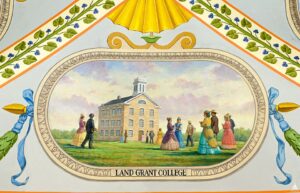
Land sales under the Morrill Act generated about $190 million, measured in 2026 dollars. Some states used their proceeds to expand existing universities, such as Michigan State, Penn State, and the University of Wisconsin. Other states established new institutions. Prominent examples: Kansas State University (the first institution established as a land-grant college, in 1863), the University of Illinois at Urbana-Champaign (1867), Purdue University (1869), and The Ohio State University (1870).
In a few cases, states used their land-grant money to fund agriculture and engineering programs at private institutions. Two of America’s original land-grant universities were the Massachusetts Institute of Technology (founded in 1861) and Cornell University (1865). Even today, Cornell retains an unusual governance structure, as a private institution with public-sector responsibilities assigned by the New York State Legislature and with elected officials on its board of trustees. Fully a third of all proceeds from land sales under the 1862 act went to Cornell, since New York officials proved exceptionally astute in picking their land parcels and selling them at a high price.
After the Civil War, Southern states reversed course and embraced the opportunities offered by the Morrill Act. Georgia expanded its flagship University of Georgia, North Carolina and Virginia established North Carolina State University and Virginia Tech as complements to their existing public flagships, and Texas passed legislation to establish what became Texas A&M University as the state’s first public university in 1871, 10 years before establishing the University of Texas.
Total enrollment in U.S. colleges and universities almost quadrupled from 1869 to 1900, according to Department of Education data. As a percentage of college-age Americans, enrollment reached about 3.5% by 1900 and 7% by 1940. Land-grant universities accounted for about 30% of total enrollment and a majority of all students enrolled in public institutions in 1900. Most land-grant institutions admitted women from day one or early in their history, though a few – like Texas A&M – declined to do so until well into the 20th century.
America pulled far ahead of European peers in college going, with about four times more students as a percentage of its college-age population than Britain, France, or Germany in 1900. The nation went on to widen its lead over the next 100 years.
The United States also established a large lead in trained engineers. The number of Americans with an undergraduate engineering degree rose sevenfold between 1866 and 1880 and another 15-fold by 1911. By the First World War, the United States had far more engineers than any other country in the world as a share of its population, education leaders Gordon Gee and Stephen Gavazzi show in their book Land-Grant Universities for the Future: Higher Education for the Public Good.
Land-grant universities additionally helped America achieve outsized increases in agricultural productivity between 1870 and 1940, though they came under criticism from late-19th century farm organizations like the Grange for drawing so many young people from farm families into urban engineering jobs.
The most powerful criticism of the Morrill Act today is that the federal government’s property grants in many cases consisted of land seized from Native American peoples, often in violation of the U.S. government’s treaty commitments. Some Native American activists refer to the institutions established in these places as “land-grab universities.”
Later legislation expands the reach of federal support for higher education
In 1890, Congress passed a second Morrill Land-Grant Act, also sponsored by Justin Morrill. This legislation enabled the establishment of 17 additional institutions, mostly colleges aimed at serving Black students in the segregated South, like Alabama A&M University, North Carolina A&T, and Prairie View A&M in Texas. The second Morrill Act represented the culmination of decades of activism by Frederick Douglass, Robert Scott of South Carolina, and other Black leaders.
More recently, Congress extended land-grant status and benefits to several institutions in Puerto Rico and other U.S.-controlled territories in 1972 and to 29 Native American tribal colleges and universities in 1994.
As a result of these measures, America’s roster of land-grant colleges and universities now includes 112 institutions. These include 57 “1862 institutions,” 19 “1890 institutions,” and 36 institutions that received the designation in the 20th or 21st centuries. Land-grant colleges and universities today account for about 11% of the nation’s undergraduate population, 15% of graduate student enrollment, and almost 40% of STEM Ph.D. degrees granted each year, according to the Postsecondary National Policy Institute and the Association of Public and Land-Grant Universities (APLU).
Congress also passed a series of measures that have given rise to significant federally-funded research activities at land-grant universities and similar institutions.
- Under the 1887 Hatch Act, Congress launched a program to fund agricultural research stations at many land-grant institutions, representing America’s first foray into public funding for science research and development.
- In 1914, Congress started funding extension services to bring university agricultural R&D to farming communities through the Smith-Lever Act.
- In 1966, Congress created a program to fund marine research at designated “sea-grant” universities through the National Oceanic and Atmospheric Administration, which named 34 recipients including the University of California at San Diego, the University of Maryland, and Oregon State University.
- The Lyndon B. Johnson and Ronald Reagan Administrations launched policies to expand the geographic reach of science funding programs overseen by the National Institutes of Health and the National Science Foundation, with the effect of expanding R&D activities at many land-grant universities and other institutions beyond the group of private universities and state flagships that have dominated science research since World War II.
Land-grant institutions account for a little over a quarter of federally-funded research today, and a significantly larger share of research in agriculture and engineering.
Land-grant colleges and universities have become a less distinct category within America’s higher education sector since World War II. The GI Bills of 1944 and 1945 – subject of a George W. Bush Institute-SMU essay I wrote last year – as well as later legislation dramatically expanded college access further by providing tuition assistance dollars that followed the student, regardless of whether they attended a land-grant university, state flagship, regional commuter school, community college, or private institution.
Academic offerings at land-grant institutions have grown much closer to those of other universities than they were in the late 19th century. Research activities at land-grant universities have also become more like those of state flagship institutions and leading private universities.
The main significance of being a land-grant institution today is not so much differences in curriculum, research, or funding models. It is, rather, the distinctive culture that many land-grant universities continue to embody. Ask a land-grant university president about the culture of their institution, and they’ll likely bring up the democratic spirit and sense of responsibility to the surrounding community that comes with their land-grant heritage.
A commission focused on the future of land-grant colleges and universities in the late 1990s spoke of the “covenant” between land-grant institutions and the people of their state. Contrasting land-grant universities with other American universities, the commission found that the former, at their best, still stood for the values of accessibility, opportunity, external community engagement, academic neutrality on contentious political issues, and research that contains a “healthy dose” of practical applied work. The commission concluded: “The irreducible idea is that we exist to advance the common good.”
The creation of America’s land-grant colleges and universities was a key milestone that profoundly influenced the subsequent evolution of the nation’s economy. Justin Morrill is not represented in the Capitol’s National Statuary Hall, but Ohio State, Michigan State, and Iowa State all have buildings bearing his name. It’s a fitting way to remember a little known but immensely consequential American leader.