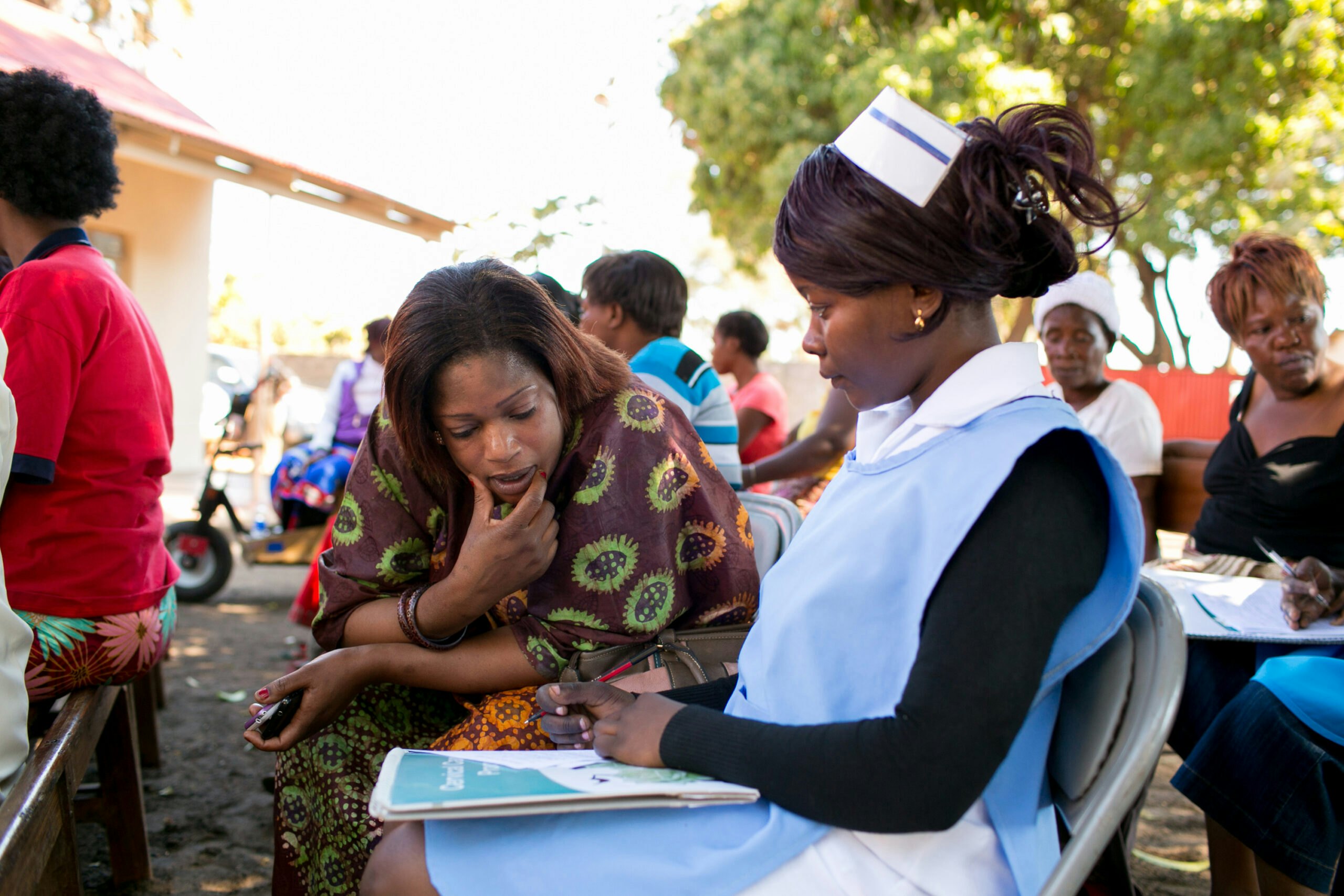
Josephine Nabukenya was born HIV-positive in Uganda in 1993. Thanks to treatment, care, and support through organizations supported by the President’s Emergency Plan for AIDS Relief (PEPFAR), today she is living a happy, healthy life and helping other children and young people living with chronic illnesses. “I’ve been able to achieve a very healthy life and achieve my dreams,” Josephine told us.
Her story is the latest addition to the George W. Bush Institute’s The Lasting Impact of America’s Global Health Legacy, which highlights the people and communities whose futures have been transformed by programs including PEPFAR, the President’s Malaria Initiative (PMI), and the Global Fund to Fight AIDS, Tuberculosis, and Malaria. Josephine demonstrates what more than two decades of sustained U.S. investment can make possible: lifesaving treatment, stronger communities, and a generation empowered to lead and give back.
America First Global Health Strategy Updates
To make bilateral health agreements signed under the America First Global Health Strategy more transparent, Public Citizen has created a repository of documents released through the U.S. Department of State’s Case Act reporting process, Freedom of Information Act (FOIA) requests, and other public sources. It includes full texts for a subset of bilateral health agreements, along with specimen-sharing agreements and implementation materials. Some documents obtained through FOIA or other sources have not been definitively confirmed by partner governments as the final official versions of their agreements. As of Sept. 12, 2026, the U.S. and partner countries have signed 35 bilateral health agreements, totaling approximately $24.1 billion in announced investment.
According to Devex, the State Department notified Congress that several countries will have government-to-government financing. The U.S. also intends to launch implementation plans (originally due in April) on Oct. 1. Unlike MOUs, these plans have not been made available to the public.
Under the latest agreement between the U.S. and Vietnam, the United States will provide $98.75 million in global health funding, including $21.4 million for global health security, as Vietnam assumes full ownership of its HIV/AIDS and tuberculosis programs over the five-year agreement period. Vietnam enters this transition with a strong foundation in its fight against HIV. In the George W. Bush Institute’s PEPFAR Beyond 30 series, Dr. Deborah Birx, Dr. William Steiger, and I highlighted Vietnam as a country on track toward the 95-95-95 HIV targets. Joint investment by PEPFAR and the Vietnamese government, policy reforms that expanded services for vulnerable populations, and the inclusion of HIV treatment in Vietnam’s national health insurance scheme helped increase treatment coverage as PEPFAR investment scaled down from $98 million in 2010 to $37 million in 2024. This experience provides important context as Vietnam takes on greater financial and programmatic responsibility under the new agreement.
The State Department also offered additional implementation opportunities through its Advancing Global Health Annual Program Statement, which is expected to provide up to $4.5 billion across as many as 100 awards. Applications closed on Sept. 15 for opportunities in Cameroon, Côte d’Ivoire, and Mozambique designed to “complement, extend, and/or fill identified gaps” in bilateral MOU implementation. The country-specific opportunities offered up to $5.4 million for Cameroon, $50 million for Côte d’Ivoire, and $180 million for Mozambique, subject to funding availability.
Bush Institute Insights
- President George W. Bush’s upcoming book, The Call of Freedom: Portraits of Political Prisoners and Dissidents, highlights the courage and resilience of people who have stood against repression, imprisonment, and exile. Available March 9, 2027, the book features 44 full-color portraits of men and women from around the world who have faced persecution because of their ethnicity, gender, political positions, or religious beliefs. An accompanying exhibit will open the same day at the George W. Bush Presidential Museum.
- The George W. Bush Institute recently joined Friends of the Global Fight Against AIDS, Tuberculosis, and Malaria, Malaria No More, and other partners for a Convening on the Future of U.S. Leadership Against Malaria. The discussion brought together leaders including Global Fund Executive Director Peter Sands and Gavi CEO Dr. Sania Nishtar to examine emerging challenges and opportunities across malaria research, innovation, financing, and policy, as well as priorities for malaria elimination. The convening comes at an important moment for the malaria response. New tools and innovation have created opportunities to accelerate progress, but sustained financing, strong health systems, and continued U.S. leadership remain essential to ensure those innovations reach the communities that need them most.
Ally Updates
Think Global Health has updated its interactive tracker examining the financing commitments behind bilateral health agreements under the America First Global Health Strategy. As of Sept. 29, 2026 the analysis examined 35 MOUs governing over $24 billion in health spending through 2030, including roughly 40% in co-investment from partner governments. Think Global Health’s review of available agreement texts finds that cofinancing expectations vary sharply by country and, in some cases, outpace projected growth in domestic health budgets. Among the 16 agreements with annual cofinancing data, half are projected to see total health spending decline by 2030, despite increases in partner-country contributions.
Additionally, available MOU texts suggest governments will play a central role in implementation, with some agreements maintaining roles for faith-based organizations, NGOs, and existing implementing partners during the transition.
Figure of the Week
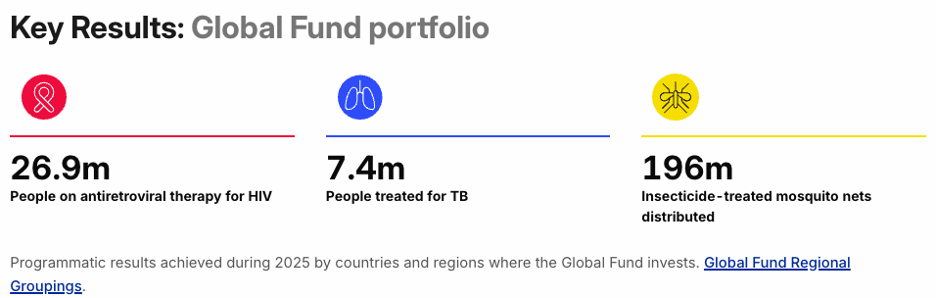
26.9 million people on antiretroviral therapy for HIV in 2025
The Global Fund’s 2026 Results Report shows that 26.9 million people were receiving antiretroviral therapy for HIV in 2025 across countries where the Fund invests, up from 25.6 million the previous year. Despite significant financing pressures, the Fund and partnering countries treated 7.4 million people for tuberculosis and distributed 196 million insecticide-treated mosquito nets, including dual active ingredient nets. In areas with rising rates of insecticide resistance, these nets can reduce malaria cases by up to 45% compared with standard nets. The Fund also supported countries in expanding access to new tools, including the rollout of lenacapavir and AI-enabled digital chest X-rays for TB screening, which can reduce image analysis from two days to just seconds.
In the News
- One year after its launch, the Accra Reset’s independent high-level panel released A Sovereign Future for Health, a report outlining practical steps to achieve greater country control over health systems and resources. The report introduces five shifts in the current operating model and 10 recommendations to reshape global health architecture around country-defined priorities, domestic resource mobilization, and more equitable partnerships. At the 81st United Nations General Assembly, Ghanaian President John Dramani Mahama said the recommendations should move the framework from design to implementation. Ghana is already putting those ideas into practice by increasing domestic resource mobilization, exploring a national budget line for immunizations, and recruiting 16,000 more health professionals this year, said Ghana Health Minister Kwabena Mintah Akandoh.
- Countries in Africa lost nearly 70% of its external financing for health between 2021 and 2025. Additionally, the continent produces less than 1% of its vaccines while carrying about 25% of the global disease burden, according to the Accra Reset’s A Sovereign Future for Health report. These pressures have forced countries to adapt quickly, including Nigeria which had to assume the costs of 28,000 former USAID-funded health workers, estimated at $200 million. The Accra Reset argues that donor countries should not disengage but should support country-led transitions that strengthen self-reliance and protect essential services.
- On Sept. 25, 2026, the United Nations convened a high-level meeting on pandemic prevention, preparedness, and response during General Assembly High-level Week. The meeting focused on a multilateral, intergenerational approach to pandemic preparedness guided by equity and solidarity. According to Health Policy Watch, a High-Level Declaration was not approved by consensus by the United Nations General Assembly. Several countries, including the United States, blocked a consensus on the draft text. During the last meeting in 2025, the Pathogen Access and Benefit Sharing (PABS) annex was left unresolved. If the annex were to be included in the agreement, countries would share pathogen samples and data to prevent outbreaks in return for a 20% set-aside of real-time health products to countries in need. Ongoing negotiations under the America First Global Health Strategy not only reflect these debates but have been a challenging consideration for negotiators.
- AI is accelerating drug discovery, protein design, and biomanufacturing, but people can also use these tools to cause biological harm, says House Investigations and Oversight Subcommittee Chairman Rich McCormick. In a recent congressional hearing on how the U.S. can strengthen biotechnology leadership, witnesses emphasized that biotechnology policy can benefit global health, including through outbreak surveillance, vaccine and medical countermeasure development, international research collaboration, and preparedness for emerging pathogens. However, as these tools become more powerful and widely available, strong and effective safeguards will be essential to ensure biotechnology advances lifesaving innovation without increasing the risk of accidental or deliberate biological threats.
- The Ebola response in the Democratic Republic of the Congo (DRC) is facing growing pressure as responders work amid an active humanitarian emergency caused by violence in the country’s eastern provinces. As of Sept. 22, 2026, the Ebola outbreak has spread to seven provinces within the DRC, with a total of 7,773 confirmed cases and 3,759 deaths. The WHO has allocated 20,000 doses of the Ervebo vaccine for a research vaccination program in Ituri province, where frontline health workers and others at increased risk of exposure will participate in a trial to better understand whether the vaccine protects against the Ebola Bundibugyo strain. The latest Global Report on Food Crises update also notes that acute food insecurity in the DRC remains high, with worsening financing conditions, conflict, and El Niño expected to worsen conditions into 2027. “Ebola feeds on delay, fear and hunger,” said Carl Skau, World Food Programme’s acting Executive Director. “Food assistance is frontline Ebola containment.”
- Fiji has declared a national HIV emergency as the country faces a sharp rise in infections, with roughly 1 in 60 people estimated to be living with HIV, CNN reports. Only 39% of people living with HIV in Fiji know their status, and fewer than a quarter are receiving treatment, far below global averages. Fiji plans to expand HIV testing, treatment, access to PrEP, and needle and syringe programs, while officials warn that stigma and limited awareness continue to prevent people from seeking care.