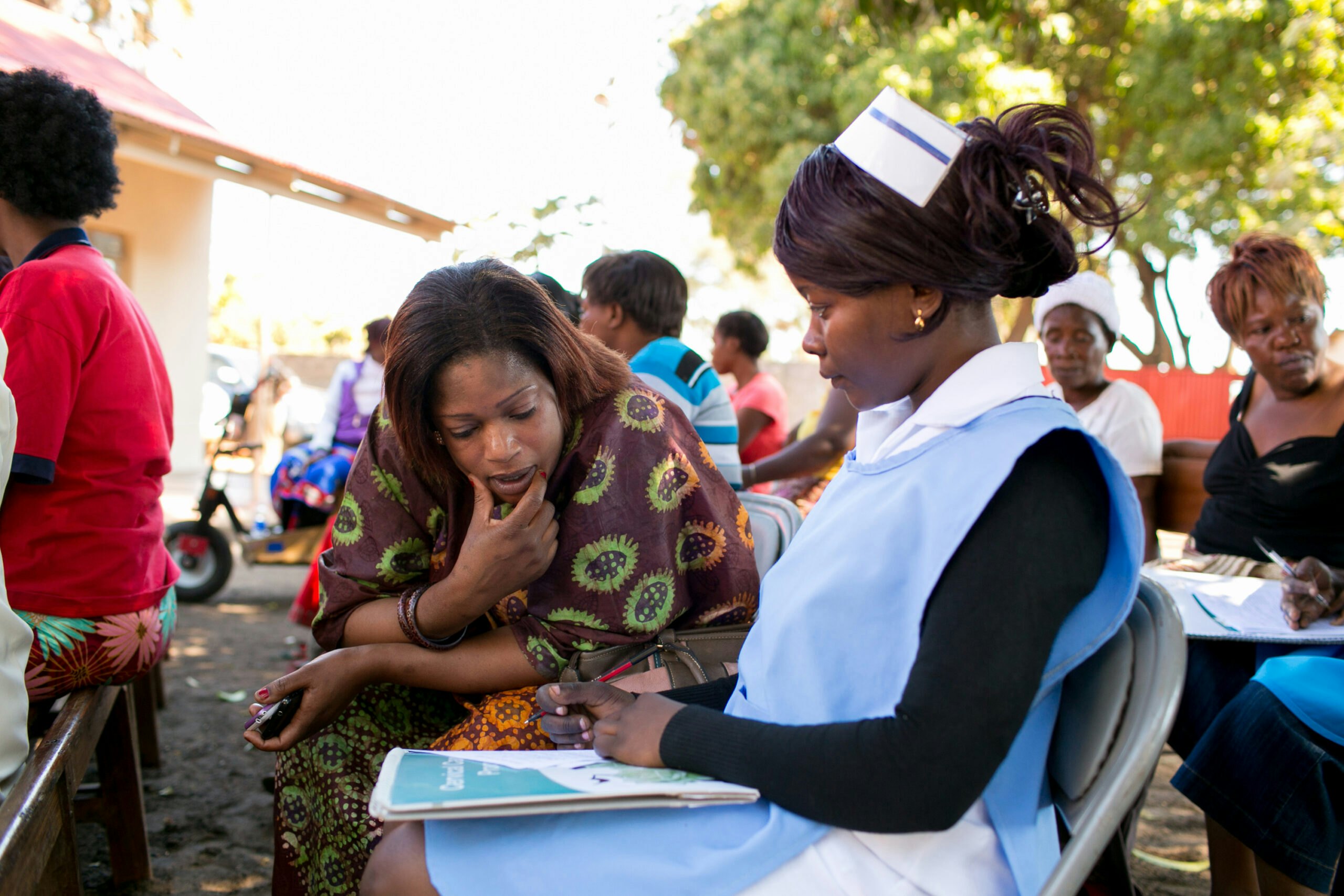
As Congress returns from its August recess, lawmakers have an opportunity to reengage on the future of U.S. global health leadership. The latest installment of the George W. Bush Institute’s The Lasting Impact of America’s Global Health Legacy shows what is at stake. Olivia Ngou, founder and Executive Director of Impact Santé Afrique, remembers growing up seeing people hospitalized and dying from malaria. Today, she says, those deaths are far less common because of investments through programs including the U.S. President’s Malaria Initiative and the Global Fund to Fight AIDS, Tuberculosis, and Malaria, alongside scientific innovation and stronger health systems.
Stories like Olivia’s are a reminder that U.S. global health investments have delivered extraordinary and measurable results over decades. After months of negotiations, the America First Global Health Strategy is moving to implementation, making congressional oversight, reliable financing, and a continued focus on measurable results especially important. The next phase should build on success, protect hard-won progress, and ensure U.S. global health partnerships continue saving lives.
Bush Institute Insights
The State Department’s new $2 billion investment in faith-based and community organizations is a welcome step toward strengthening local health systems. However, local African faith-based health organizations are seeking clarity on their role in the State Department’s new investment, DevEx reports.
Last week, Samaritan’s Purse announced that they will not accept $300 million of the directed funds. Additionally, while at least 80% of resources are expected to support frontline services, leaders in Zambia and Ghana say it remains unclear how much funding will reach local organizations. Ensuring these resources reach frontline providers will require clear definitions, transparent metrics, and strong oversight.
In a new Bush Institute explainer, Senior Fellow Dr. Deborah L. Birx, CEO of Malaria No More Bill Steiger, and I look at how lessons from PEPFAR’s successful integration of community organizations can be applied to the America First Global Health Strategy’s new framework. It is essential and practical that the majority of the funding be directed locally. Many local faith-based organizations have been U.S. partners for decades, have demonstrated the highest level of accountability, and can meet U.S. funding requirements without the overhead costs of international faith-based organizational support. We recommend the State Department return to direct funding of these local organizations to ensure maximum efficiency and effectiveness of U.S. taxpayer dollars.
In addition to the Bush Institute’s recently released recommendations to ensure the success of the America First Global Health Strategy, Congress should ask the State Department to hold partners accountable, integrate their expertise into planning and oversight, and rigorously evaluate their work to ensure the intended outcomes of these gifts are achieved.
To learn more about PEPFAR’s process and the recommendations, read the explainer here: “What the U.S. Department of State’s commitment to faith-based organizations means for the America First Global Health Strategy.”
America First Global Health Strategy Updates
- The U.S. State Department Annual Program Statement (APS) is providing up to $4.5 billion in global health investment over five years through as many as 100 awards. About $1.4 billion is currently open for applications or nearing award. Recent addenda include up to $162 million for neglected tropical diseases across 32 countries, $115 million for nutrition programming in 12 countries, and $180 million to support programming in Mozambique. The competitive process is open to organizations including local and international NGOs, faith-based organizations, private companies, universities, and government entities. However, unlike past awards, the Bureau of Global Health Security and Diplomacy has indicated that APS is a way for the Bureau to bring in new partners and complement existing government-led efforts rather than expand funding to international NGOs.
- In a letter to Secretary of State Marco Rubio, Representative Robert Garcia, Ranking Member of the House Committee on Oversight and Government Reform, stated that the “PEPFAR program has had strong bipartisan support since its inception in 2003. Through medical assistance and preventive care, the program has saved the lives of 26 million people across more than 50 countries who would have died from AIDS.” Rep. Garcia is requesting a detailed accounting of PEPFAR funds released and withheld since January 2025, as well as information on the Centers for Disease Control and Prevention’s role in PEPFAR implementation.
Figure of the Week
5,000+ Ebola cases in the Democratic Republic of the Congo (DRC)
The Ebola outbreak in the DRC has reached over 5,000 cases and over 2,000 deaths, making it the country’s largest Ebola outbreak on record. The outbreak has spread about three times faster than during the 2014-2016 West Africa outbreak, which was the deadliest on record. Insecurity, displacement, population movements, and attacks on health workers have made it difficult for responders to reach affected communities.
The outbreak is caused by the rare Bundibugyo virus, for which no approved vaccines or treatments exist. While the Ervebo vaccine is approved for another strain of Ebola, its effectiveness against Bundibugyo has not been established. The World Health Organization has allocated 70,000 doses of the Ervebo vaccine to Congo, including 20,000 for a late-stage trial to determine whether it can protect against Bundibugyo. Gavi, the Vaccine Alliance, will provide $13 million to support vaccine delivery and vaccination efforts in high-risk areas. The U.S. has also pledged $375 million in the first two months of the response, already surpassing initial U.S. financing for the two previous largest Ebola outbreaks.
Ally Updates
When it comes to the new bilateral agreements signed under the America First Global Health Strategy, the implementation of these agreements is what will make all the difference. The Center for Global Development (CGD) recently examined three direct donor-to-partner government financing models in Ethiopia, Rwanda, and Jordan to spotlight various approaches to implementation.
- In Ethiopia, the World Bank’s $350 million maternal and child health program worked through the national health plan and a pooled donor fund, linking payments to measurable results. By strengthening government systems, the program helped increase skilled birth attendance from 10% in 2011 to 50% in 2019.
- In Rwanda, the Global Fund ties HIV, TB, and malaria financing to performance and domestic co-investment while relying heavily on national data and audit systems. The model demonstrates how strong country systems can support greater ownership with a smaller donor staffing footprint.
- In Jordan, USAID helped establish a $109 million pooled donor fund that expanded refugees’ access to public health services, incentivized lower health care fees, reduced duplicative donor requirements, and strengthened infrastructure benefiting refugees and Jordanians alike.
Across the three cases, CGD finds that effective government-to-government financing depends on strong country systems, clear results, rigorous oversight, and program designs tailored to local capacity and context.
In the News
- Former U.S. Global AIDS Coordinator Mark Dybul told Devex’s Theory of Change podcast that PEPFAR was always intended to transition toward greater country ownership, arguing that the program missed opportunities over the past two decades to shift more responsibility to partner governments. According to Dybul, the next 12 to 18 months will be a critical window in which global health programs must adapt to a model centered on country sovereignty, local innovation, and mutual economic partnership. If they don’t, the entire architecture might collapse.
- The National Institutes of Health (NIH) has ended its ban on funding new research projects in South Africa, a country with one of the strongest clinical trial infrastructures for HIV, tuberculosis, and other infectious diseases. In an internal memo obtained by Science, NIH Director Jay Bhattacharya outlined new requirements for international research, including that projects have a clear scientific rationale for being conducted abroad and the potential to generate knowledge that protects or improves the health of Americans. South African Medical Research Council President Ntobeko Ntusi welcomed the decision, saying, “No country can ever solve the challenges of global health alone. History has taught us that, in science, we are stronger when we stand together.”
- Health Policy Watch examines how African countries are adapting as U.S.-supported HIV programs transition toward greater country ownership. Zambia has protected antiretroviral treatment for 1.3 million people living with HIV but cut services including community testing, male circumcision, and DREAMS programming for women and girls, while South Africa faces the loss of thousands of frontline health workers. Zambia’s National HIV Program Coordinator Dr. Lloyd Mulenga said countries are now searching for lower-cost models to sustain care, “It’s going to be tough, but we have to find cheaper, sustainable options.”
- Several reports note that America’s Famine Early Warning Systems Network (FEWS NET) has stopped monitoring Afghanistan, Somalia, and Yemen, where an estimated 27.5 million people need food assistance. The loss of reliable data makes it harder to direct limited resources to these countries. Food insecurity compounds existing health and security crises.
- Incoming Unitaid executive director Dr. Luis Pizarro told Devex that existing treatments for HIV, malaria, and tuberculosis should not slow investment in new tools. Pointing to the development of a single-dose oral treatment for sleeping sickness, improved pediatric HIV medicines, and ongoing gaps in Ebola treatment, he said: “Sometimes people think all the innovation is already there…I think we have shown that’s not true.” Pizarro also sees growing research investment in countries such as Brazil, India, and South Africa as an opportunity to build stronger national research systems and prepare for future outbreaks.