The World Cup is a moment to celebrate what connects us, and to invest in a future where both Africa and North America can thrive. For the first time, 10 African nations qualified for the World Cup, meaning that at the start, the continent accounted for one-fifth of the tournament field. That milestone is worth celebrating. It is also a reminder that North America’s relationship with Africa extends far beyond the soccer field. The U.S. and the African continent already share $83.4 billion in total trade, and across the U.S., Canada, and Mexico, 14 of the 16 World Cup host cities have sister-city ties with African communities. These connections have been built through trade partnerships, educational and cultural exchanges, diaspora communities, and innovative collaborations.
To showcase how soccer, trade, innovation, and opportunity connect Africa with the 2026 World Cup hosts, the George W. Bush Institute and the ONE Campaign have launched More Than a Match, a new digital experience.
U.S. policymakers should recognize that stronger U.S. engagement with Africa can deepen economic ties, strengthen global health security, expand opportunity, and reinforce partnerships grounded in transparency, accountability, and shared prosperity.
Bush Institute Insights
While the U.S. and countries across Africa already have a strong relationship, More Than a Match reminds us that there is a great opportunity ahead. The match on the field lasts 90 minutes, but the partnership it represents has the potential to go much further. Africa’s young population, growing markets, and entrepreneurial energy make the continent essential to global prosperity and security.
Global health has long been one of the clearest examples of what an effective U.S.-Africa partnership can achieve. The President’s Emergency Plan for AIDS Relief (PEPFAR) has saved more than 26 million lives and has advanced health care infrastructure, good governance, and more than $1 trillion in economic benefit. The President’s Malaria Initiative (PMI) has prevented 2 billion malaria infections in countries across Africa, which shoulder more than 90% of the world’s malaria burden. These programs show that investing in the rights and well-being of Africans across the continent has a direct impact on peace and prosperity around the world.
U.S. policymakers should build on what has worked: accountable, country-led partnerships that save lives, strengthen local systems, expand economic opportunity, and advance democratic values.
America First Global Health Strategy Updates
The U.S. Department of State announced more than $240 million in humanitarian and disaster response assistance to Catholic Relief Services (CRS), the first in a series of awards to trusted and vetted implementing organizations. The funding will support the rapid deployment of lifesaving assistance, with CRS able to respond within 24 hours to crises around the world. CRS will provide multi-sectoral support, including food, nutrition, health, water and sanitation, and shelter assistance in countries with significant humanitarian needs such as the Democratic Republic of the Congo (DRC), Ethiopia, Haiti, Nigeria, and Sudan. The award will also supplement CRS’s Ebola response in the DRC and support a global rapid response fund that can bypass lengthy procurement processes. The State Department emphasized that partnering with CRS and other faith-based partners will make humanitarian assistance more efficient and accountable to U.S. taxpayers.
Figure of the Week
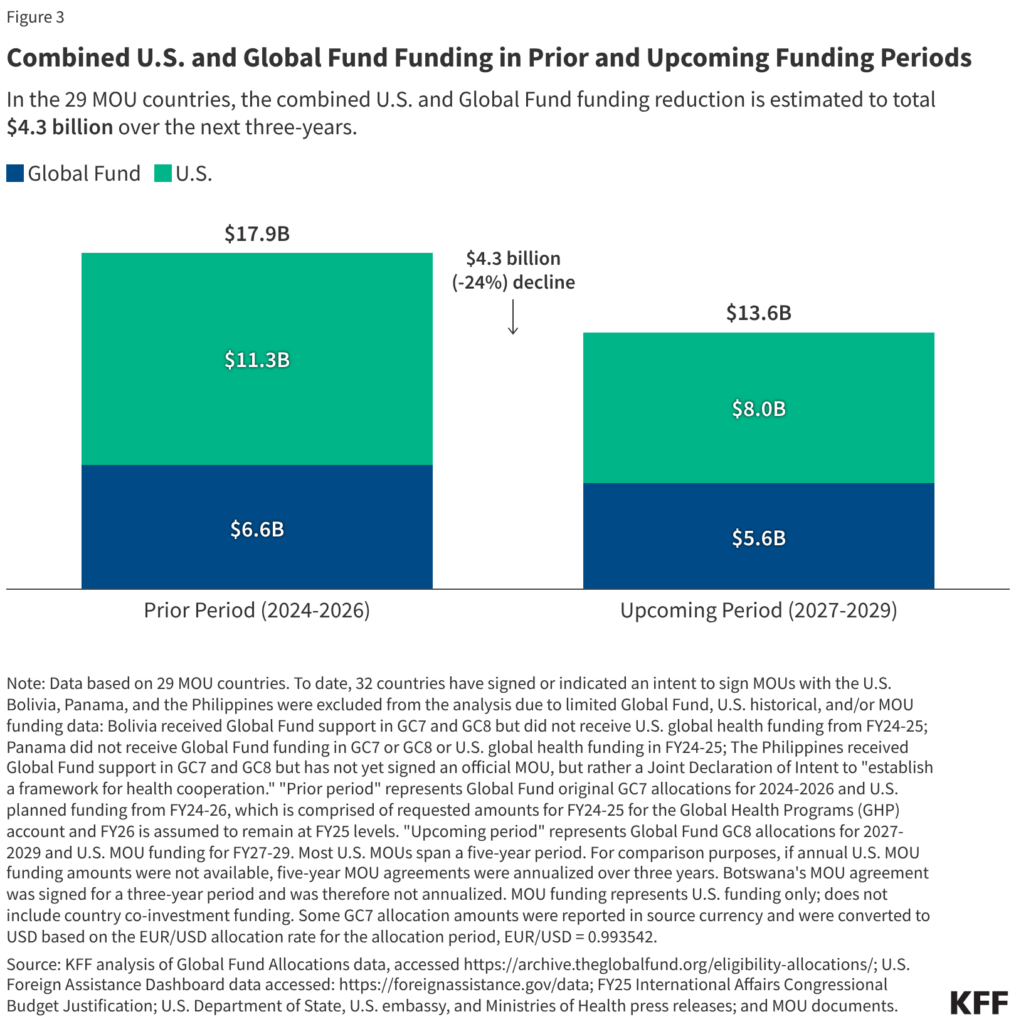
$4.3 billion reduction in combined U.S. and Global Fund funding in 29 MOU countries
29 countries with bilateral health agreements under the America First Global Health Strategy are expected to see a combined $4.3 billion reduction in U.S. and Global Fund support between the 2024-2026 and 2027-2029 periods, according to a recent KFF analysis. As illustrated in the graph below, this represents a 24% decline, with combined support falling from $17.9 billion to $13.6 billion. KFF notes that about half of the MOU countries will experience reductions of $100 million or more, with the largest dollar declines in Mozambique, Uganda, Nigeria, and Malawi.
It’s worth noting that as the world approaches 2030 and countries get closer to ending HIV/AIDS as a global health threat, a gradual decline in bilateral funding is expected. However, significant cuts or an abrupt termination could leave American allies ill-prepared to maintain progress and save lives.
Ally Updates:
The 2026 United Nations (U.N.) General Assembly High-Level Meeting on HIV/AIDS on June 22 and 23 reviewed progress against HIV since the 2021 High-Level Meeting and established a new Political Declaration on HIV and AIDS, including global targets for 2030. UNAIDS said the declaration will serve as the global accountability mechanism for all member states’ HIV/AIDS efforts over the next five years.
Early drafts of the new U.N. Political Declaration seek to reaffirm member states’ “unwavering commitment” to end AIDS as a public health threat by 2030. The draft builds on the UNAIDS Global AIDS Strategy for 2026-2031, including goals for testing, treatment adherence, integration into health systems, and mobilizing the $21.9 billion that UNAIDS estimates will be needed annually by 2030.
On June 22, the UN General Assembly adopted the political declaration on HIV/AIDS. One hundred and forty-nine (149) countries voted in favor, while 8 voted against the resolution, including the United States, which cited the declaration’s divergence from the 95-95-95 targets, and 14 abstained from voting.
Additionally, a new UNAIDS report finds that ending AIDS as a public health threat by 2030 remains within reach if countries, communities, and global partners act decisively. Meeting the 2030 targets could avert 3.2 million new HIV infections and 1.2 million AIDS-related deaths between 2025 and 2030. These gains depend on expanding treatment access and viral suppression, scaling prevention, reducing stigma and discrimination, strengthening community-led services, and securing sustainable financing. As countries move toward greater ownership and co-financing, responsible transition planning, clear accountability, and sustained support for lifesaving programs will be critical.
In the News
- On CBS News’ Face the Nation with Margaret Brennan, Dr. Deborah Birx, former U.S. Global AIDS Coordinator and senior fellow at the Bush Institute, discussed the escalating Ebola outbreak in the DRC and noted that the virus likely spread through several cycles of infection before it was reported. This delayed detection and underreporting make it difficult to understand the true scope of new infections. Dr. Birx said the U.S. has strengthened hospital biocontainment capacity since past Ebola cases and praised the creation of an interagency Ebola response task force, noting that U.S. personnel, funding, and assets are already on the ground. She also emphasized the need to examine why African CDC and laboratory systems did not detect the outbreak sooner and how to strengthen early warning capacity.
- During his meetings this month on Capitol Hill, Secretary of State Marco Rubio said, “…we don’t want aid to solely be judged by how much you spend; we want it to be judged by what its results are.” Chris Collins, President and CEO of Friends of the Global Fight Against AIDS, Tuberculosis, and Malaria released a new piece focused on the key aspects that it will take to make the America First Global Health Strategy a success. They include tailoring transition to each country’s unique situation and allow the time it requires; securing data on service levels and outcomes; scaling effective innovations; investing in community service systems; and coordinating bilateral and Global Fund programming.
- A new AIM-HPV implementation research study from the Elizabeth Glaser Pediatric AIDS Foundation found that integrating HPV vaccinations into HIV prevention and treatment services can increase vaccine uptake among adolescent girls at elevated risk of cervical cancer. The study reviewed records from 6,377 girls ages 9-14 across 54 health facilities and surrounding communities in Mozambique and Zimbabwe. After integration, first-dose coverage among girls living with HIV reached 95.8% in Zimbabwe and 69.6% in Mozambique. Caregivers also strongly supported the approach, with nearly all satisfied with vaccination in integrated settings. The study shows how existing HIV platforms can deliver other lifesaving prevention services to girls at higher risk.
- As of June 16, 837 Ebola cases have been confirmed in the DRC, and 19 cases have been confirmed in Uganda. The U.S. State Department announced that the U.S. will provide $50 million to the Coalition for Epidemic Preparedness Innovations to develop medical countermeasures for the Bundibugyo strain of Ebola. Several outlets have reported on the status of the epidemic. Investigators suspected that a cracked coffin and funeral for Pastor Paluku Makundi Denis may have caused one of the outbreak’s earliest superspreader events, reports Reuters. The New York Times examines how the DRC’s gold economy, marked by constant movement of miners, traders, and smugglers, has made containment especially difficult. Reuters reports that China has revised its Ebola prevention plan and increased monitoring for travelers from affected areas to reduce the risk of imported cases. BBC highlights rare stories of survival and recovery from Ebola in the Ituri province of the DRC.
- On June 5, South Africa became the ninth African country to introduce lenacapavir for HIV prevention, a twice-yearly injectable PrEP option that could expand choices for people at risk of HIV. South Africa’s status as the world’s largest PrEP market makes the rollout critical to building demand for lenacapavir and helping lower prices across the continent. Zambia, Eswatini, Zimbabwe, Lesotho, and Mozambique are also planning lenacapavir mass rollout campaigns. The Global Fund announced that support for the rollouts will increase from $29 million to nearly $70 million with backing from the Children’s Investment Fund Foundation. According to advocates, the impact will depend on quickly turning commitments into orders, maintaining reliable supply chains, and ensuring communities most in need can access the drug.
- Senators Todd Young (R-Ind.) and Jeanne Shaheen (D-N.H.) reintroduced the bipartisan End Tuberculosis Now Act, which would strengthen U.S. efforts to prevent, diagnose, treat, and ultimately eliminate tuberculosis worldwide. The legislation aligns with the Administration’s global health goals by advancing targeted, results-driven investments that reduce the burden of one of the world’s deadliest infectious diseases while strengthening preparedness for future infectious disease threats. “By investing in TB prevention and response abroad, we save lives and protect Americans from infectious disease threats before they reach our shores,” Senator Shaheen said in a press release.
- Friends of the Global Fight released a new report outlining how donor transitions could put civil society organizations (CSOs) at risk unless governments, the U.S., and the Global Fund create clear plans to sustain their work. The report emphasizes that CSOs deliver frontline HIV and tuberculosis services, often reaching vulnerable populations that public-sector systems cannot. Local CSOs managed nearly 20% of Global Fund grants from 2017 to 2022, providing services such as mobile TB testing and adherence support for people on HIV treatment. However, many CSOs remain heavily dependent on external donors. To prevent service disruptions during transition, the report calls for domestic social contracting, dedicated budget lines, legal authority, and stronger reporting on CSO roles, costs, and readiness.
- The Guardian reports that the World Health Organization (WHO) approved Coartem Baby, the first malaria treatment designed for newborns and infants as small as 2kg. This major milestone will help close a dangerous treatment gap in parts of Africa, where up to 18% of children under six months can be infected with malaria. However, Dr. Marcus Lacerda, Director of the WHO-hosted Special Programme for Research and Training in Tropical Diseases, notes in Health Policy Watch that scientific advances will not be enough on their own. Countries need the support and determination required to put existing malaria tools into practice