
Four Years In:
Ukraine can still win


With U.S. and European help, Ukraine can still win the war Russia started
On this fourth anniversary of Russia’s full-scale invasion of Ukraine, we take stock of where things stand with Russia and Ukraine and what the West needs to do to help end the worst conflict on the European continent since World War II.
- Russia’s Vladimir Putin, who launched the war for no good reason, is not interested in ending it. Putin thinks he is winning and is given rosy assessments by his generals and intelligence services. He also thinks he can outlast Western support for Ukraine. In reality, Russia is not winning the war, and the de minimis territorial gains it has achieved have come at enormous costs in Russian troops and materiel.
- Ukraine is holding on and bravely defending its people and territory, albeit at significant human costs. Last year was the deadliest for Ukrainian civilians since the start of the full-scale war, with civilian casualties up 31% from 2024.
- The Europeans need to do much more to support Ukraine and tighten the screws on Russia’s economy, though they have increased their commitments to Kyiv. They need to insert themselves into U.S.-led peace efforts, especially if they are to play a key role in security guarantees for Ukraine.
- The United States needs to rethink its approach to the war and relaunch significant military support for Ukraine. Washington should stop applying pressure on the victim of Russian aggression, Ukraine – for territorial concessions and elections – and ramp up pressure against the guilty warmonger, Russia.
1
RUSSIA IS, WAS, AND WILL BE THE PROBLEM
By David J. Kramer
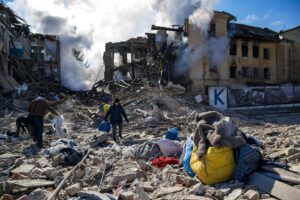
Feb. 24, 2022, marks the start of Russia’s full-scale invasion of Ukraine, but the war actually began a dozen years ago, when Moscow seized and illegally annexed Ukraine’s Crimean peninsula and then moved into the Donbas region. Russian forces killed more than 14,000 Ukrainians between 2014 and 2022. The toll on both sides over the past four years has been exponentially worse.
Sole responsibility for this war lies with Vladimir Putin. He doesn’t recognize Ukraine as an independent state and seeks to restore Russia’s status as a great power by controlling countries along Russia’s borders.
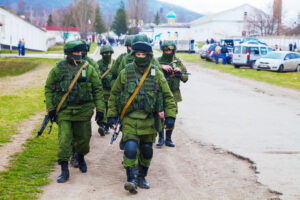
He wants to undermine Ukraine’s hopes of becoming a truly independent, Western-oriented, democratic state that could pose a threatening alternative to Putin’s fascist, corrupt system of government. And he doesn’t seem to care about the toll the war is taking on Russia’s population – or at least he won’t unless and until the deteriorating situation threatens his grip on power or he runs out of men to carry out his orders.
U.S. officials over the past year have claimed numerous times that “Russia wants to make a deal” and that Ukraine and Russia are “closer than ever before” to a peace deal following recent negotiations. Russian Foreign Minister Sergei Lavrov dismissed such claims, saying, “there is still a long way to go.” Russian actions on the battlefield show no signs of letting up. Russian officials insist any settlement must address what it calls the root causes:
- Removal of the current government in Kyiv (which the Kremlin describes as “de-Nazification” even though Ukraine’s president, Volodymyr Zelenskyy, is Jewish) and its replacement by a supplicant, pro-Russian regime.
- Permanent neutrality (i.e., no NATO membership).
- Demilitarization of Ukraine’s formidable military.
- Recognition of Russian territorial gains and surrender of lands Ukraine still controls.
Moscow also wants all sanctions lifted and the return of the $300 billion in Russian assets frozen in Western financial institutions. Russia, in other words, offers no concessions of its own but insists on compromises it knows are unacceptable to Ukraine – and should be unacceptable to Europe and the United States.
Putin refuses to implement and observe a ceasefire to pause the fighting, and Russia has significantly ramped up its missile and drone attacks against Ukraine rather than show any interest in ending the war. It seeks to freeze Ukrainians into submission by targeting energy facilities and power plants during the coldest winter since the full-scale invasion started.
Putin thinks he’s winning the war. Quite simply, he isn’t. Russia’s generals and intelligence tell Putin that Russia is making major gains, when, in reality, their forces have achieved little – capturing less than 1% of additional Ukrainian territory in 2025 – and at enormous costs in loss of Russian lives and materiel. A report by the Center for Strategic and International Studies recently estimated Russian losses at 1.2 million – 415,000 dead, wounded and missing last year alone – and possibly reaching 2 million (when combined with Ukrainian losses) later this year. Russian troop casualties in January exceeded the number of newly mobilized and contracted soldiers for the second consecutive month, according to Ukrainian calculations.
“Putin thinks he’s winning the war. Quite simply, he isn’t.”
This makes staffing the Russian military campaign difficult and has led Russian officials to turn increasingly to foreign fighters “often recruited under false pretenses and press-ganged under pressure,” according to U.K. Defense Secretary John Healey. He estimated the number of North Korean troops committed to fighting for Russia at about 17,000. Officials already have emptied much of Russia’s prison population with offers of freedom after military service – if they survive.
In addition, Russia’s economic outlook is dire. Oil and gas revenues, the main source of income financing Putin’s war, plummeted by more than 50%, exacerbating Russia’s already challenging budget situation. Military-related spending constitutes roughly half of the Russian state budget, a percentage that is not sustainable over the medium and long term, and defense spending constitutes some 8% of Russia’s GDP. On top of that are U.S. sanctions imposed last October on Russia’s largest oil companies, Rosneft and Lukoil, and pressure on India to reduce Russian energy imports.
As a result, the Wall Street Journal recently reported, “Dozens of tankers filled with Russian oil are floating at sea without buyers. Western powers are seizing the aging ships the country relies upon. Buyers of Russian oil are demanding the steepest discount to global oil prices since the early months of the war in Ukraine.”
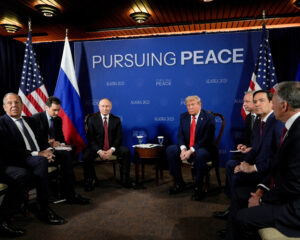
And yet Putin thinks he can outlast the West in its support for Ukraine. He refuses to budge at the negotiating table from his core goals enumerated above. Russia has made no concessions and seeks to gain at the talks what it has been unable to achieve on the battlefield. Officials in Moscow claim that Russia and the United States reached some ill-defined agreement when Putin met with President Donald Trump last August in Alaska. Publicly, nothing coming out of that meeting indicated there was agreement between the two sides, and yet the U.S. administration has not refuted Russia’s claims of some understanding.
The Kremlin views Zelenskyy, whose term would have ended in 2024 had Russia not invaded, as illegitimate. It rejects any deployment of European peacekeeping forces to serve as security guarantees for Ukraine as legitimate targets for Russian missiles and drones. The Kremlin and its propagandists argue that Europe, NATO, and Ukraine are responsible for war breaking out. During the Biden Administration, they also blamed the United States; those accusations were tempered following President Trump’s inauguration, but, more recently, they have criticized Washington for not following through on what was supposedly agreed to in Anchorage.
“They tell us that the Ukrainian issue needs to be resolved. In Anchorage, we accepted the proposal of the U.S.,” Lavrov said. “They made an offer, we agreed, and the problem should have been resolved. It seems that they proposed it and we were ready – and now they are not.”
At the same time, Russian officials have dangled the prospect of massive business deals between Russia and the United States, to the tune potentially of $14 trillion. That would be seven times Russia’s current GDP. Russian officials want to convince the U.S. administration that Ukraine is a hindrance to better days ahead for Moscow and Washington.
2
UKRAINE’S FIGHT FOR FREEDOM
By Igor Khrestin
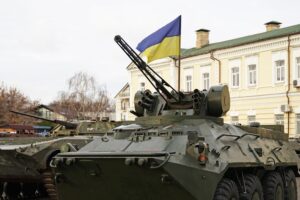
Defending Ukraine against Russian aggression has taken a horrific toll on the country both since the full-scale war with Russia began four years ago and since Russia’s initial invasion in 2014. Tens of thousands of Ukrainian military personnel have died or been injured, and 2025 was the deadliest year for Ukrainian civilians since the full-scale invasion began, according to the United Nations.
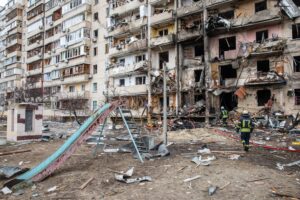
Ukraine’s economy has shrunk by 30% since 2022, and it would take at least until 2030 for Ukraine’s economy to recover to pre-invasion levels according to the European Union. Ukraine has lost 13% of its territory since the full-scale invasion, and about 20% since the initial invasion a dozen years ago. Russia’s campaign of “blackout warfare” has nearly destroyed the Ukrainian electric grid in the middle of the coldest winter in generations. Ukraine’s recovery and modernization costs are now estimated at $1 trillion and counting.
But Ukraine and Ukrainians are far from giving up their fight for freedom and sovereignty. In fact, Ukraine has made significant strides to ensure the nation’s continued survival in the face of a better-manned and better-equipped adversary. In recent days, Ukrainian forces have recaptured the most territory from Russia since 2023. The economy is battered but remains relatively stable.
“But Ukraine and Ukrainians are far from giving up their fight for freedom and sovereignty.”
Only 17% of Ukrainians would support a peace deal with Russia on the Kremlin’s terms, according to a survey conducted last year by the Kyiv International Institute of Sociology (KIIS), Ukraine’s premier pollster. President Volodymyr Zelenskyy’s approval rating among Ukrainians was still 67%, according to Gallup in July, despite a sharp drop-off since 2022.
In the face of sharply declining U.S. military assistance, European and Ukrainian defense industries have stepped up to partially fill the void. President Zelenskyy stated in September 2025 that Ukraine produces nearly 60% of its own battlefield equipment. Ukraine’s drone industry has particularly blossomed: As of December 2025, more than 95% of all of Ukraine’s battlefield drones are domestically produced. In turn, drone strikes are responsible for approximately 70% of all Russian casualties, and some 90% of Russian combat vehicle losses.
As of October 2025, Ukraine produces more mortar shells and artillery shells than all 32 NATO nations combined. Ukraine’s defense production capacity stood at over $35 billion in 2025, compared with $1 billion in 2022. Ukraine now produces its own long-range cruise missiles, cruise-missile-like drones, and a coterie of seaborne unmanned surface vessels that have all but incapacitated Russia’s vaunted Black Sea Fleet. Ukraine’s long-range drone and missile campaign against Russia’s energy infrastructure is causing significant damage to Russia’s oil industry, the lifeblood of the Kremlin’s wartime economy.
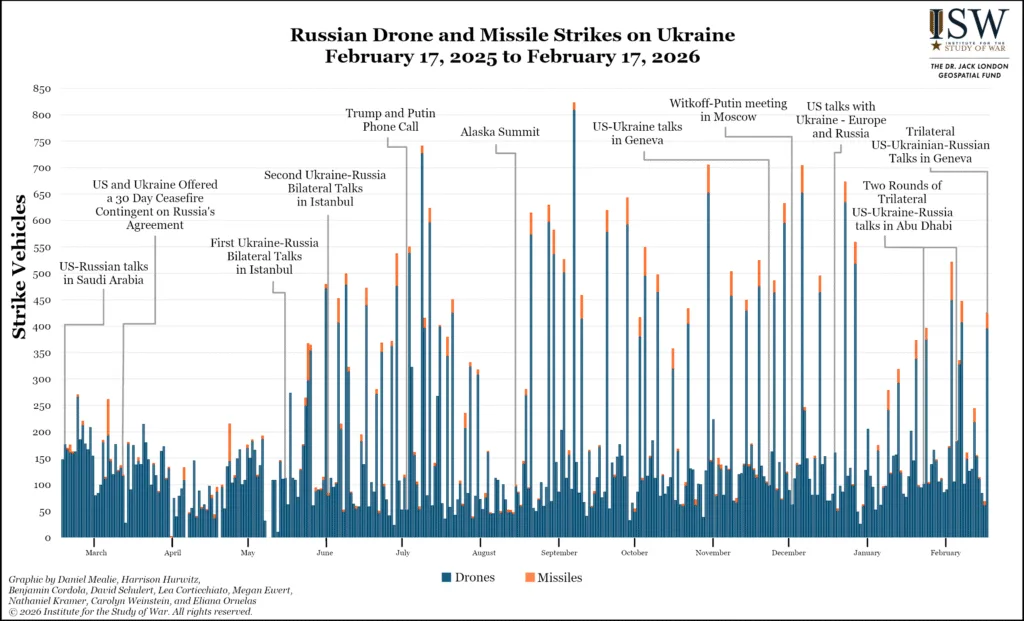
But as the old defense industry axiom goes: “Quantity has a quality all of its own.” With support from China, which now accounts for some 60% of Russia’s war needs, the Russians have scaled up their defense production capacity to match – and in many cases substantially exceed – Ukraine’s capabilities. The Russian advantage is particularly pronounced in missile defense systems, long-range missiles, and Russia’s ability to manufacture heavy Shahed-type drones on an industrial scale. These drones and missiles now terrorize Ukrainian cities by the hundreds on a near-daily basis.
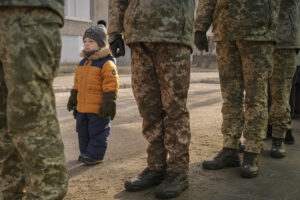
Arguably, Ukraine’s most significant battlefield disadvantage remains manpower. Until recently, Russia had been able to virtually fully regenerate its massive battlefield losses with fresh recruits. Boosted by hefty financial incentives, Russians are choosing to die in great numbers rather than live mired in poverty in some of Russia’s poorest regions – a phenomenon liberal Russian economist Vladislav Inozemtsev termed as “Deathonomics.” For Ukraine, the situation is unfortunately the reverse: Recruitment numbers are well below what is needed to replenish battlefield losses, while desertion rates have escalated sharply.
Ukraine’s manpower crisis has been further exacerbated by a baffling government decision last year to allow males aged 18 to 22 to freely leave the country. In the months following that decision, an estimated 100,000 young men have done just that. The resulting shortages have contributed to large undefended gaps in Ukraine’s 750-mile front line, which the Russians have exploited to devastating effect. Moreover, Russian forces have also quickly technologically adopted to the new way of war, forcing the Ukrainians to seek ever new means to remain ahead in the defense innovation cycle.
To succeed in 2026, Ukraine needs to do the following:
- Expand the domestic defense industry. Through great sacrifice, Ukraine has fully learned the bitter lessons of the 1994 Budapest Memorandum and the Minsk Agreements, which failed to prevent full-scale Russian aggression. Thus, Ukraine’s priority for 2026 should be to produce as much domestic war materiel as possible. This will require painful tradeoffs vis-à-vis other urgent economic needs, but Ukraine and Ukrainians have little choice in the matter.
- Fix the manpower shortage. Ukraine must find a way to reverse, or at least to partially compensate for, the severe manpower disadvantage vis-à-vis Russia. This is not only a front line infantry problem. Leading analyst Michael Kofman argues that “as the fighting shifts from combat infantry to drone units and specialists, losses become increasingly difficult to replace because people serving in those positions require much more training to develop specialized expertise.” Ukraine needs to remedy this – and do so as fast as possible to minimize the resulting Russian gains.
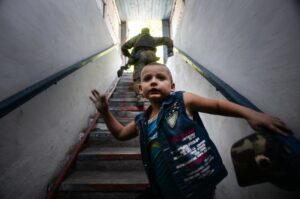
Boy looks around as he climbs stairs from a bomb shelter after shelling in the Petrovskiy district of Donetsk, eastern Ukraine on Aug. 26, 2014. (AP Photo/Mstislav Chernov)
- Institutionalize governance reforms. Even in wartime, Ukraine must remain laser-focused on fulfilling all of the institutional requirements for eventual entry into the European Union. Ukraine’s European future is why tens of thousands of Ukrainians have chosen to lay down their lives since the Euromaidan protests in 2013, which was a wave of public demonstrations against the pro-Russian government of Viktor Yanukovych that eventually led to Yanukovych fleeing to Russia. To honor the memory of those killed since and those who are fighting today, the Ukrainian government cannot veer away from the European path. This commitment should include robust anti-corruption efforts because corruption has unfortunately persisted since 2022 and caused political unrest in Kyiv. These scandals also give the Kremlin and its anti-Ukraine allies around the world a prime propaganda opportunity. Ukraine can and must do better.
In the words of Ukraine’s national poet Taras Shevchenko: “Fight, and you will prevail.” These words – and the deeds behind them by millions of brave Ukrainians – are keeping Ukraine in the fight for its survival as a free, independent, and democratic nation.
3
EUROPE NEEDS TO STEP UP
By Elizabeth Kennedy Trudeau
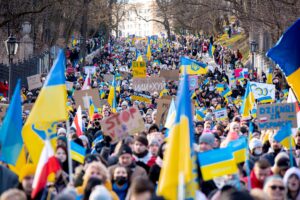
No more slogans. Four years after Russia’s full-scale invasion of Ukraine, Europe has reached the point where “#UnitedforUkraine” should not be the subject of a think-tank panel or a tired summit conclusion, but an actionable, implementable policy with money, munitions, and political discipline.
Europe’s resolve to stand with Ukraine is not in question, but Europe must harness its own power and commit to action even as its own domestic politics shift, budgets tighten, and U.S. engagement becomes less predictable. This means making available to Ukraine Russia’s frozen assets under legally defensible mechanisms, streamlining the industrial and logistical pipeline for sustained military support, and actively seeking to cement European-wide political cohesion through tangible sanctions that are actually enforced.
While European leaders continue to rightly discuss new immediate military packages, including air-defense missiles, Ukraine’s needs are structural, not episodic. Ukraine needs sustained, predictable support, not periodic visits to Kyiv.
“Four years after Russia’s full-scale invasion of Ukraine, Europe has reached the point where “#UnitedforUkraine” should not be the subject of a think-tank panel or a tired summit conclusion, but an actionable, implementable policy with money, munitions, and political discipline.”
All signals indicate Russia remains committed for a long war. Europe must both support Ukraine in this continued grind and stay ahead of Russian adaptation for Europe’s own security and strategic interests.
Translated into policy, this means:
- Move from simply freezing Russian assets to legally durable financing for Ukraine.
To Europe’s great credit, it has immobilized a large share of Russia’s sovereign reserves. Much of it is sitting under European control. The current debate – whether to seize these Russian assets now to support Ukraine – raises both legal concerns in some European capitals and, perhaps more worryingly, fear of potential Russian retaliation.
- This can be a two-stage solution: Europe should continue to accelerate frozen Russian asset income, including windfall profits generated on reserves, directly to Ukraine while a multicountry structure, such as a European Union-controlled mechanism, is established. The longer-term solution, and the appropriate response commensurate to Russia’s brutal full-scale invasion, will be full confiscation, with funding targeted for Ukraine’s rebuilding post-conflict.
- Fix military support bottlenecks and prioritize European leadership in NATO.
Ukraine is fighting a war on Europe’s doorstep. Europe must ensure Ukraine receives ammunition and air defense that not only allows it to keep pace with Russia’s attacks, but to win. While there have been strategic efforts to streamline supply chains, such as the ammunition procurement initiative, funding gaps and short-term contracts have hobbled these initiatives. Europe’s focus should be sustained, politically backed, and predictable output, not emergency purchasing in response to summit declarations. Europe should also prioritize ensuring the most fragile parts of Ukraine’s defense receive the highest priority support. Front-loading air and missile defense systems to protect civilian centers and Ukraine’s energy grid will counteract Russia’s targeting of energy and civilian infrastructure designed to break Ukrainian popular backing for the fight.
- Europe should also continue supporting NATO’s role as a logistical platform. The alliance’s leadership has stepped forward to coordinate production targets, transportation of materiel, and other logistics across European territory. NATO’s Prioritized Ukraine Requirements List (PURL) has provided the framework for NATO allies to fund the purchase of U.S. weapons for Ukraine, while the NATO Security Assistance and Training for Ukraine (NSATU) command has stepped in to facilitate the pipeline of equipment and training for Ukrainian forces.
- European allies should continue to robustly move forward with this ownership of planning, coordination, and force generation for eastern allies. It is clear that European consensus inside the North Atlantic Council signals the resolve of the alliance and reliability to Kyiv. It’s also clear that these moves serve as deterrence to Moscow and other nefarious actors who are watching this conflict, and NATO’s response, closely.
- Levy new sanctions and enforce current ones.
While the EU has continued to add sanctions, including measures targeting Russia’s shadow fleet, Russia has – just as swiftly – learned how to evade, reorganize, and route around restrictions. As this war drags on, Russia must feel its economy choked, and the enablers of this war isolated. While sanctions enforcement remains a global issue, Europe can take a more muscular approach by imposing systemwide, tooth-to-tail pressure on oil export logistics. In February, the European Commission proposed a sweeping ban on services that support Russia’s seaborne crude oil exports, going beyond earlier measures.
- Plan now for post conflict security guarantees.
The U.K. and France formally agreed to assume responsibility for a post-ceasefire military deployment in Ukraine as part of longer-term security guarantees. Their clear hope is that the United States would be a key player in that military coalition. U.S. leadership will be critical in assuming substantive roles in military and political leadership as a Russian deterrent, as well as monitoring and verification of the ceasefire. This intensive planning should continue, and other European partners brought actively into the planning, with clear benchmarks, defined contributions and responsibilities for all, including the United States.
- Focus on energy; end exemptions.
Europe also needs to continue its efforts on energy diversification. The EU has agreed to ban Russian liquefied natural gas (LNG) by January 2027, with a full prohibition on all Russian gas by late next year. This type of cohesive political leadership matters. A sanctions policy must be matched with enforcement, energy discipline and shared political will, and there should be no exemptions made for Hungary, Slovakia, or any other European country. A fractured system is simply something Moscow could wait out.
Europe’s objective should be clear: keep Ukraine politically engaged, its citizens supported, and its military capable, while showing Russia that borders in Europe cannot be changed by force. That requires financing utilizing Russian assets, a defense production and delivery system that matches the war’s scale, and sanctions that are enforced like national security. Europe needs to move beyond summit platitudes and take concrete action to develop to security guarantees.
Ukraine is fighting a war it didn’t seek. There is one offender in this conflict, Russia, and Europe’s political and military cohesion will reduce the odds that the next war will be fought even closer to home.
4
TIME FOR A DIFFERENT U.S. APPROACH
By David J. Kramer, Igor Khrestin, and Elizabeth Kennedy Trudeau
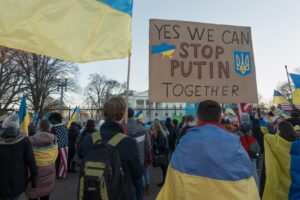
For the past year, the current U.S. administration has acted as a “neutral arbiter” to maintain the ability to talk with both sides of the Russia-Ukraine war. This marked a change from its predecessor, which stated that it would support Ukraine “for as long as it takes” but did not specify what that meant and sought to isolate, not engage, its Russian counterparts.
The United States should stand unequivocally with Ukraine. It should recognize that Vladimir Putin isn’t interested in peace unless he can force Ukraine into submission. The United States should not be helping him achieve that goal. Putin sees U.S. pressure on Ukraine as a sign that he is winning and that the West’s support is waning.
“The United States should stand unequivocally with Ukraine. It should recognize that Vladimir Putin isn’t interested in peace unless he can force Ukraine into submission. The United States should not be helping him achieve that goal.”
The only language Putin understands is strength, and the United States should demonstrate that in the following ways:
- Resuming military assistance for Ukraine. This could be through increased use of the Prioritized Ukraine Requirements List (PURL), a mechanism by which the United States sells weapons to Ukraine via NATO partners, or direct military assistance through the congressional budget process. U.S. military aid to Ukraine fell by 99% in 2025. That sends a bad signal to Kyiv and Moscow.
- Supporting a European-led force to provide much-needed security guarantees for Ukraine.
- Tightening sanctions against Russian energy and financial entities and increasing the crackdown on the “shadow fleet” that Russia depends on for skirting sanctions. The U.S. government took an important step in this direction last fall when it imposed wide-ranging sanctions against Rosneft and Lukoil, the country’s two largest oil producers. Long-languishing legislation in the U.S. House and Senate that would ramp up sanctions should move forward.
- Insisting on a ceasefire, which the Trump Administration supported until the infamous meeting in Anchorage last August. If Putin can’t agree to this, then he won’t agree to any end to the war.
- Including the Europeans in any further negotiations. It is difficult to demand that Europe do more to help Ukraine while cutting Europe out of any talks.
- Joining Europeans in seizing the $300 billion in frozen Russian assets, the bulk of which lies in European financial institutions.
- Pressuring China to end its support for Russia’s war effort. Beijing provides electronics and dual-use technology vital to Russian drones and other military needs. Washington should make Beijing’s support for Russia a key agenda item when Trump meets with Chinese leader Xi in a few weeks – the way the White House pressured India.
- Rejecting any Russian ideas of returning to bilateral business as usual. As it is, Russia is unlikely to lure many U.S. businesses to its inhospitable market.
- Pressing for accountability for Russian war crimes so that such egregious actions do not go unpunished or get repeated.