


Updated March 13, 2026
The war in Iran may cause U.S. gasoline prices at the pump to average more than $4 a gallon for the first time in almost four years, some industry experts predict – even though the United States doesn’t import any oil from Iran.
In fact, America’s biggest foreign oil suppliers aren’t based in the Middle East at all. Almost 57% of oil and petroleum product imports into the United States last year came from Canada, followed by 6.4% from Mexico, according to data from the U.S. Energy Information Administration, part of the Energy Department. Just 8.5% of U.S. imports originated in the Persian Gulf last year – a far cry from 25 years ago, when it supplied 23%.
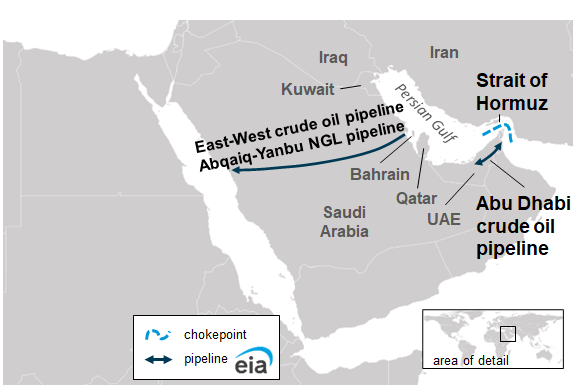
But the fact that the United States doesn’t directly use much Persian Gulf oil doesn’t shield U.S. consumers from sticker shock. Oil is the most widely traded commodity in the world, refined into products like gasoline, diesel, and jet fuel, and global markets are linked. So supply issues in key parts of the world can be felt at home. This is what’s happening now because the war has essentially halted tankers moving oil through the Strait of Hormuz, at the mouth of the Persian Gulf between Iran and Oman.
“The war in the Middle East is creating the largest supply disruption in the history of the global oil market,” the International Energy Agency, a group of 32 industrialized nations including the United States, said in a report Thursday. The IEA announced Wednesday that members would release 400 million barrels of oil from stockpiles to mitigate the crisis. But that essentially puts a Band-Aid on the problem.
The U.S. Energy Department identifies the Strait of Hormuz as one of the world’s most important oil transit “chokepoints” because oil equivalent to about a fifth of the world’s daily consumption passes through the passage on its way to global shipping corridors.
About 20.1 million barrels a day of oil transits the channel, according to U.S. estimates. All else being equal, that means that the coordinated IEA release – the largest in the history of the organization – will make up for just 20 days of lost Persian Gulf supply.
Saudi Arabia, the United Arab Emirates, Kuwait, and Iraq are among Gulf producers starting to cut oil output because there’s nowhere for it to go and their storage options are filling up, reports showed this week. The IEA forecast Thursday that Gulf countries have already cut total oil production by at least 10 million barrels a day.
There are two pipelines that can serve as workarounds for the strait – one in Saudi Arabia and one in the United Arab Emirates. But these pipelines only have the capacity to move 22% of the oil that usually goes through the strait each day, according to the Energy Department.
The average retail U.S. gasoline price reached $3.63 a gallon on Friday, March 13, up from just below $3 before the conflict, and topped $5 in California, data from the American Automobile Association, or AAA, shows. The jump came as the U.S. benchmark oil futures price has surged more than 42% from the start of the conflict through Thursday.
Published Energy Department modeling is based on the assumption that oil production constraints will peak in early April – just a few weeks away – then gradually return to normal as full traffic through the strait resumes, according to an analysis released Tuesday. But the duration of the conflict remains uncertain.
“If this reduction in vessel volume persists, oil storage behind the chokepoint will quickly fill, causing oil producers to shut in even more production, lending further support to oil prices,” according to the monthly Short-Term Energy Outlook released Tuesday by the Energy Information Administration, the data arm of the U.S. Energy Department.
The agency estimates that the world will use an average of 105.17 million barrels a day of oil this year, so another way of looking at the 400 million barrel global release from strategic petroleum reserves is that it will cover just under four days of total global consumption.
Asia is likely to feel most of the pain from the current disruptions, since the vast majority of the energy products that transit the strait go to places like China, India, Japan, and South Korea. U.S. oil imports from the countries in the Persian Gulf actually fell to the lowest level in 40 years last year because of a surge in domestic U.S. production, according to the Energy Department.
So the United States isn’t at immediate risk of gasoline shortages because of lack of oil from the Persian Gulf, as occurred during the OPEC oil embargo of the 1970s. That conflict led to long gas lines. OPEC – the Organization of Petroleum Exporting Countries, which includes Saudi Arabia, Iran, and Iraq, as well as Venezuela, Nigeria, and others – provided just 14% of U.S. oil imports in 2025, down from 47% as recently as 2001.
Still, products refined from oil are essential to the global economy, so high oil prices can have a trickle-down effect from industrial costs in addition to affecting what consumers pay to fuel their cars, heat their homes, and fly on a plane. Asphalt and petrochemicals used to make plastics, fertilizer, and other chemicals are all refined from oil.
While President Trump’s comments on the war nearing an end reassured markets that the Strait of Hormuz could reopen sooner rather than later, it will likely take a while for things to return to normal, and gasoline prices could still rise further until the situation is resolved.
Fuel prices typically go up during the spring months anyway, because motorists drive more and refiners switch to summer-blend gasoline, a more expensive, cleaner-burning fuel mandated by the U.S. Environmental Protection Agency.
But the uncertainty around the conflict and the conditions at the strait may keep prices volatile and elevated for some time, however.
So Americans may still be in for a rollercoaster when it comes to prices.
Margot Habiby is deputy director of communications at the George W. Bush Institute. Previously, she spent almost 25 years as an energy reporter and editor for Bloomberg News and Dow Jones Newswires, including a stint as Dow Jones’ chief Middle East correspondent covering OPEC.


