


Nerds like me will immediately know the line: “To boldly go where no one has gone before.”
But even the “cool kids” may recognize that one. It’s the rallying call of the Star Trek franchise.
That idea of venturing beyond our known boundaries captures the irrepressible nature of the human spirit. It’s one of our best qualities. We have an unquenchable desire to discover, learn, and grow.
It’s no coincidence that the recent Artemis II mission – which quite literally sent astronauts farther into space than ever before – has captivated the imaginations of many Americans (and Canadians – I didn’t forget you guys are part of the mission, too). Their journey has demonstrated what’s best about the human experience. Foremost, it rekindles a sense of wonder about the universe and our place within it. Perhaps more importantly, though, it offers a needed reminder that humans have the capacity to do remarkable things.
Both of those sentiments were felt when astronaut Jeremy Hansen recommended that NASA name a crater on the Moon’s surface after the late spouse of the mission’s captain, Reid Wiseman. Wiseman’s wife Carroll lost her battle with cancer in 2020.
“It’s a bright spot on the moon,” reported Hansen. “And we would like to call it ‘Carroll.’”
The crew’s act of love for their captain achieved something grander than the historical significance of the mission. By memorializing Carroll on the Moon, they made it possible for any of us gazing up at the night sky to connect directly with the Wisemans’ story.
We can sympathize with Reid’s loss, honor Carroll’s memory, and realize that people are still called to do great things, even after enduring tragedy. That potent example of hope is now engraved in our history.
A similar ethos appears in the founding of our country and the U.S. Constitution’s stated goal of forming “a more perfect union.” This aspiration describes the perpetual process by which “we the people” try to establish the common good for our society. And that sacred charge is something that should connect and inspire every American for generations to come.
How exactly does a big, diverse democracy like ours go about doing that? Yuval Levin of the American Enterprise Institute provides the best answer, arguing that “we act together” while thinking differently. This point is emphasized in our new pluralism toolkit, We the People: Pluralism in Real Life, that offers nine habits for how Americans can cooperate across differences.
Acting together can take many forms including sustained and passionate disagreements over issues big or small. But it could also be bold projects that instill a sense of wonder within people and push the limits of human potential.
In 1962, President John F. Kennedy challenged the American people with such a project as the Cold War fight for supremacy extended into space.
“We choose to go to the moon in this decade and do the other things, not because they are easy, but because they are hard,” Kennedy proclaimed. “Because that goal will serve to organize and measure the best of our energies and skills, because that challenge is one that we are willing to accept, one we are unwilling to postpone, and one which we intend to win, and the others, too.”
Kennedy’s vision to boldly go where no one had gone before was realized less than a decade later in 1969, when Americans Neil Armstrong and Buzz Aldrin became the first humans to walk on the Moon.
The Artemis II mission is a continuation of those baby steps into the universe. This potential new age of space exploration (with NASA planning to return humans to the Moon by 2028) could offer more opportunities for Americans of different stripes to act together. That could be as simple as shared prayers for the mission crews or curiosity about the mysteries of space.
At the very least, we can bond over gratitude for our little blue planet as astronaut
Victor Glover, who spoke to our Presidential Leadership Scholars (PLS) class in 2023, recently suggested when he called the Earth an “oasis.”
Glover offered similar perspective to the PLS class telling them, “Seeing the planet as it is- without border and without labels – makes you realize that we are one community.” PLS develops principled
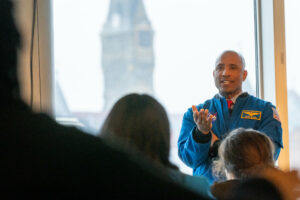
and diverse leaders who are united in common purpose; in doing so, they engage with bold leaders, like Glover, who share how they achieve success, inspire others, and solve critical challenges. And Glover’s experience of looking upon Earth from space, beautifully illustrated the idea of diverse citizens “without border and without labels” acting together for the betterment of the country.
For hundreds of millions of years this “oasis” has sustained many varieties of life that have thrived. Chief among them, though, are we humans who have created awe-inspiring architecture, art, literature, movies, music, science, sports and so much more.
Through it all, we Americans can act together in search of the common good, whether exploring the farthest reaches of the universe or the longing of the human soul.


