


To celebrate America’s 250th birthday, I will publish a series of 12 essays exploring milestone events that shaped the American economy into what it is today – from the adoption of the Declaration of Independence to the Marshall Plan. I’ll pay particular attention to the country’s formative decades and tell the stories of ideas, policies, and innovations that helped build the world’s strongest economy.
Seemingly small policies can sometimes have momentous consequences. Such was the case with America’s distinctive patent system.
The nation’s founders established the system in ways that broke with European legal systems of their era in subtle but far-reaching ways. The system they devised – one of America’s greatest ideas – has profoundly shaped the nation’s economy ever since.
America’s patent system has created the best incentives for technological innovation the world has ever seen and played a vital, if underappreciated, role in the nation’s economic growth. As Abraham Lincoln said, the patent system “added the fuel of interest to the fire of genius.”
Every U.S. state but one passed patent legislation in the years between the 1776 signing of the Declaration of Independence and the Constitutional Convention of 1787. But they based their systems loosely on the British model, and patent protection didn’t extend into neighboring states. The Continental Congress, meanwhile, failed to create a unified national system in the 1780s.
The problem with the British system is that 18th century British patent law was rooted in the ancient concept of “letters patent”: open letters identifying privileges granted by the Crown to private individuals to advance the state’s purposes. Some letters patent empowered entrepreneurs to launch businesses based on new inventions, an idea that originated in the 15th century Venetian Republic and was taken up by England during the reign of Queen Elizabeth I in the 16th century.
The British model
Britain’s patent system, however, was at once too broad and too narrow to become a powerful incentive for world-leading research and development activity in the new United States.
It was too broad because the Crown used patents to grant recipients wide-ranging rights to conduct government functions and businesses that had nothing to do with technical innovation. Most patents amounted to state-sanctioned monopolies that restrained competition without creating incentives to innovate – which probably hurt more than helped British industrialization. Queen Elizabeth, for instance, granted the explorer Sir Walter Raleigh a lucrative patent giving him the exclusive right to oversee England’s taverns.
At the same time, Britain’s system was too narrow to protect inventors adequately. The Crown was free to reject applications on arbitrary grounds, as Queen Elizabeth did when she refused to allow a novel knitting machine because it would throw some of “her” weavers out of work.
Even in the late 18th century, applying for a patent remained a cumbersome, costly process. Authorities made no effort to avoid overlapping patents, and courts mostly declined to enforce patents against infringers, so there was little incentive to seek a patent. Britain’s legal system, moreover, didn’t allow inventors to assign a patent to others, so patents could only promote real-world innovation if inventors were positioned to make and distribute their inventions at scale. Finally, the system didn’t require detailed disclosures, which would have helped subsequent inventors improve on patented inventions.
The American model
When writing the U.S. Constitution, the framers decided that the United States should improve on preexisting patent systems and incorporated this revolutionary goal into their plan for America’s federal government. Article 1, Section 8 gave Congress the power to “promote the progress of science and useful arts, by securing for limited times to authors and inventors the exclusive right to their respective writings and discoveries.”
In 1790, Congress passed America’s first patent law, empowering a committee consisting of the secretary of state, secretary of war, and attorney general to grant inventors temporary monopolies for 14 years.
Recognizing that the system needed adjustments, Congress revisited the issue three years later. The Patent Act of 1793 clarified that new products were patentable if and only if they were novel – meaning new as compared to “prior art” in their field – as well as useful and thoroughly specified in writing. The 1793 act also streamlined the process of examining applications and issuing patents by placing it entirely within the State Department.
Later decisions further refined the system. In 1836, Congress moved the process to a dedicated Patent Office, clarified disclosure rules, and lengthened some patents’ terms to 21 years. In 1883, the United States entered into the Paris Convention with European governments, for the first time establishing the principle of reciprocal protection of inventors across international borders. Congress added a statutory requirement of “nonobviousness” in 1952 – meaning only inventions not obvious to an ordinary inventor would be patentable – and clarified the right of universities to receive patents based on federally funded research in the Bayh-Dole Act of 1980.
But even in the 1790s, America’s system constituted a departure from preexisting practices:
- It restricted patents to useful inventions and cast away the concept of granting state-sanctioned monopolies to well-connected but noninnovative firms.
- It codified the principle that all citizens have the right to apply for and receive patents and established a system that was accessible, transparent, and cheap, in contrast to old systems that treated patents as privileges granted arbitrarily by the state. During the 1800s, America made good on its promise of a more democratic system by issuing patents to female and Black inventors even in an era when they couldn’t vote.
- The system established rigorous examinations to judge the novelty of inventions and for the first time aimed to avoid issuance of multiple patents covering overlapping ideas.
- U.S. courts established that patents were a legally enforceable form of property and empowered patent-holders to assign patent rights to others. AT&T and the Singer sewing machine company were among the many firms that later built large businesses based on patents in-licensed from small-scale inventors.
- The system required full disclosures and made them readily available to the public. This eased the path for other inventors to invent around a patent or improve on it as soon as the original patent issued.
America’s patent juggernaut
America’s patent system was successful by any measure. The U.S. government issued about 10,000 patents between 1793 and 1836 – a pace almost 100 times larger on a per-capita basis than Britain had experienced in the early to mid-18th century and even five times larger than Britain achieved during the heyday of its industrial revolution in the early 19th century. The United States led the world in creating industrial-scale R&D operations starting in the late 1800s.
America’s edge in homegrown innovation was one of the main factors helping the country pass Britain as the world’s largest economy just after the Civil War and become the wealthiest country on a per-capita basis by the eve of World War I. After World War II, massive federal support for science research built on the nation’s patent system to ensure U.S. preeminence in science and technology for at least six decades.
America’s technological leadership explains much of the large advantage the nation enjoys over other wealthy nations today in incomes and material well-being, as I described in a Bush Institute-SMU Economic Growth Initiative essay on this topic last year.
Notably, all six of the leaders typically viewed as America’s top-tier founders played vital roles in creating the nation’s pathbreaking patent system, despite disagreements among them on other issues.
- Benjamin Franklin, the most famous scientist in 18th century America for his work on electricity and his invention of bifocals and rocking chairs, inspired the idea that America should become the world’s most innovation friendly nation.
- John Adams, though not a scientist, co-founded the first science society in Massachusetts and became one of the leading voices calling for laws to promote “useful mechanical arts” during a busy period of state-building during the War of Independence.
- James Madison proposed including patent issuance among Congress’ powers at the Constitutional Convention and played a lead role in crafting the 1790 and 1793 acts. Madison was chiefly responsible for establishing America’s patent system on a middle path between two other possibilities: Thomas Jefferson’s early view that ideas are the common property of all humanity so America should prohibit the patenting of inventions, and an alternative view that inventors’ right to control use of their ideas is a “natural right” that should remain inviolate forever. Either of these approaches would have crippled American innovation.
- George Washington forcefully called for patent legislation in early 1790, despite his reluctance to step on Congress’s toes by proposing bills while he was president.
- Thomas Jefferson – who adored scientific inquiry and came around to Madison’s view that granting temporary monopolies to inventors would promote science and innovation – built the patent examination process as America’s first secretary of state and proposed the adjustments Congress enacted in 1793.
- Alexander Hamilton worked with Madison to write Article 1, Section 8 of the Constitution and promoted the use of patents to advance industrialization as America’s first Treasury Secretary.
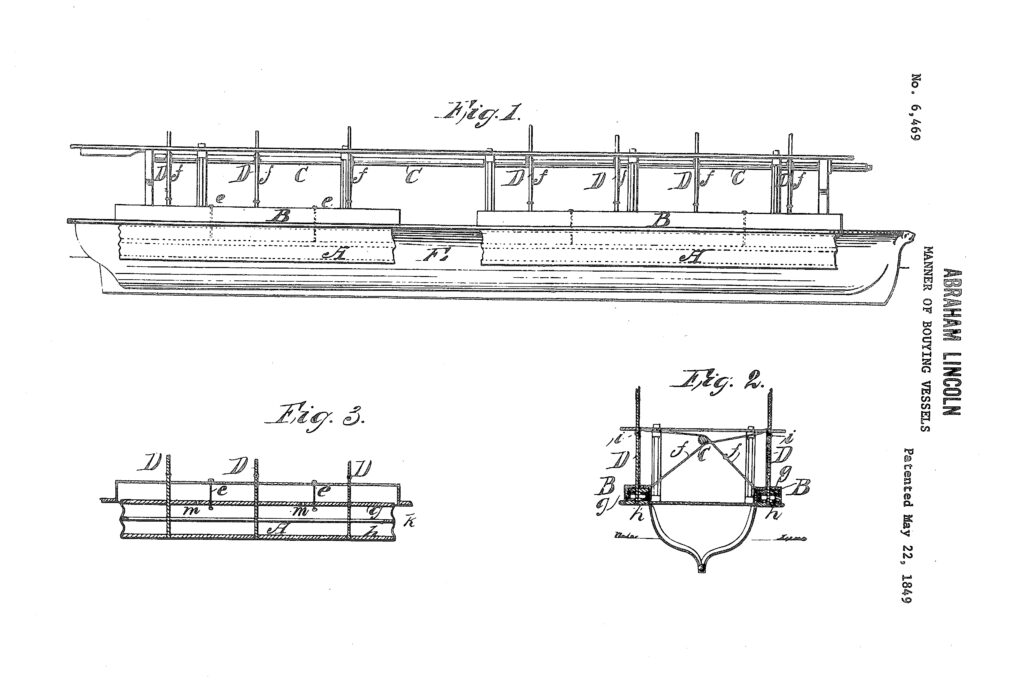
One other president deserves mention for his contribution to U.S. patent law: Lincoln received a patent for his invention of a “device to buoy vessels over shoals,” making him the only president to become a patent holder.


