
How Beijing games the global economy
Admitting China into the World Trade Organization was supposed to lead it to liberalize. In fact, the opposite has happened.
 A robot power by Nvidia chips at a technology conference in Washington, D.C., on Oct. 29, 2025.
In May 2000, the U.S. House of Representatives passed legislation required to admit China into the World Trade Organization; the Senate followed that September, and President Bill Clinton signed it into law on Oct. 10.
The House vote was closely divided, with nearly two-thirds of Democrats opposed to the bill along with 57 Republicans who defied their leadership. (The Senate, where the bill passed by an 83-15 margin, was a different story.) The fractured House vote reflected the debate in larger policy circles, which didn’t divide neatly along party lines.
In a speech he gave at Johns Hopkins University on March 8, 2000, to press for congressional approval, President Clinton argued, “By joining the WTO, China is not simply agreeing to import more of our products; it is agreeing to import one of democracy’s most cherished values: economic freedom. The more China liberalizes its economy,” he continued, “the more fully it will liberate the potential of its people – their initiative, their imagination, their remarkable spirit of enterprise. And when individuals have the power, not just to dream but to realize their dreams, they will demand a greater say.”
At the time, there was plenty of bipartisan support for such thinking. Republican Sen. Chuck Grassley, then a member of the Senate Finance Committee, said that China’s WTO entry was a “historic and important development” and that “anchoring China more firmly in the world community, and exporting our values, as well as our goods and services, is a very good thing, and will bring many benefits, including the greatest benefit of all, mutual understanding and peace.”
There was also broad opposition in both parties. Writing in The New York Times, Robert Lighthizer, who had served as President Ronald Reagan’s deputy U.S. trade representative, argued that the United States “would likely regret” the deal. Backed by major labor unions, prominent Democrats such as Rep. Nancy Pelosi warned that “China has never honored any trade agreements with the United States.”
Some 25 years after China’s entry into the WTO, it is now clear that while it did initially lead to some economic liberalization, in recent years both the country’s economy and its poitics have moved in the opposite direction. Under President Xi Jinping, Beijing has grown increasingly authoritarian. Its human rights record has not improved – in 2024, Freedom House ranked China ninth out of 100 countries on its annual Freedom in the World index, similar to its score the year of Clinton’s speech. And the Heritage Foundation now ranks China 151th of out 184 when it comes to economic freedom – a worse score than in 2001. China’s trade practices, meanwhile, have only deteriorated: In its latest report to Congress, the office of the U.S. Trade Representative (USTR) said, “China’s record of compliance with [WTO] terms has been poor” and that it “has a long record of violating, disregarding and evading existing WTO rules.”
On the national security side, meanwhile, today’s China represents a threat that is magnitudes greater than two-plus decades ago. Not only is it rearming at a blistering rate; Beijing has also become the de facto leader of a global coalition of authoritarian states (also including Russia, North Korea, and Iran, the group is sometimes referred to as CRINK) that is intent on tearing down the rules-based global order that the United States painstakingly built in the years following World War II.
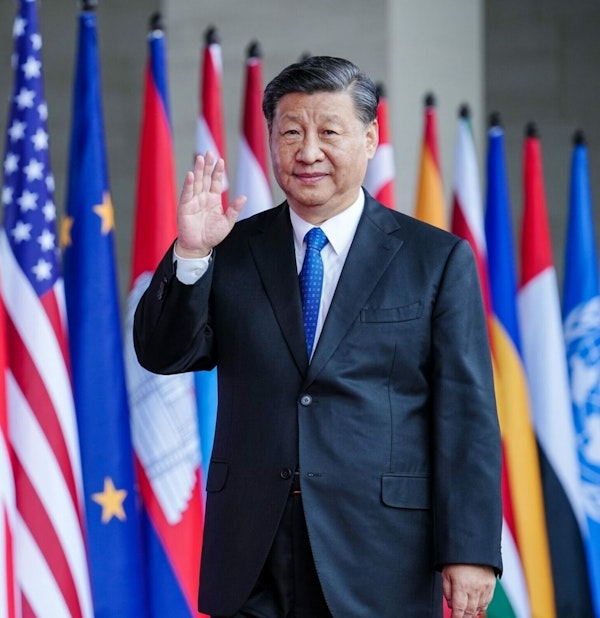 Chinese President Xi Jinping in Nusa Dua, Indonesia, Nov. 15, 2022. (Shutterstock)
Wrong from the start
In recent years, much ink has been spilled in ruminations and recriminations over how we got here and where to go next. According to China hawks, those who expected China’s economic integration to lead it to liberalize were seriously naive – a symptom of Washington’s greater strategic unseriousness, which Beijing happily took advantage of. In his 2015 book The Hundred-Year Marathon, one such hawk – the China scholar Michael Pillsbury – put it this way: “The same people who had long assured me of China’s interest in only a modest leadership role within an emerging multipolar world” would later argue that the Chinese Communist Party is now “realizing its long-term goal of restoring China to its ‘proper’ place in the world.”
Pillsbury’s view may have seemed marginal when he wrote those words 10 years ago. But it has rapidly gained support in the years since, as Beijing has consistently acted to prove the optimists wrong. Of all the ways China has abused America’s trust, Beijing’s actions on trade and technology are the most egregious – no small irony, given that this was just the sort of behavior that supporters anticipated would be fixed by China’s entry into the WTO. The 2024 USTR report to Congress concluded that, “as has been evident for some time, the WTO has been unable to effectively address China’s continued pursuit of a state-led, non-market approach to the economy and trade.”
Things have fared no better on the technology side. Contrary to expectations that China wouldn’t be able to crack down on the internet, the Chinese authorities have built the greatest technological surveillance apparatus the world has ever known, which Beijing uses to monitor its citizens and to restrict their access to outside information. In recent years, this apparatus of repression has effectively harnessed leading-edge technologies like artificial intelligence.
The Chinese government, of course, tells a different story. Speaking in Beijing last year, President Xi asserted that China is merely seeking to “build a great modern socialist country in all respects and achieve national rejuvenation through the Chinese path to modernization” – goals that sound no worse than those those pursued by his predecessors. According to Xi, what China “categorically opposes” is “imperialism, colonialism, and hegemonism,” and it is justly pushing back against “bullying practices [and] the law of the jungle.”
But as these and other statements make clear, the China doves in the United States badly overestimated both their own influence and China’s friendly intentions. As the Chinese economist Li Daokui has put it, “no one can change China from the outside. Its size and history make this impossible. You may work with China and help its leaders initiate domestic changes, but you can never change it.” What the Chinese catchphrase “win-win cooperation” with the United States really means is that China wins twice.
 China’s then Foreign Trade Minister, Shi Guangsheng, celebrates the signing of China’s WTO accession agreement in Beijing, China on May 19, 2000. (Alain Buu/Gamma-Rapho via Getty Images)
Where we go now
The debate about who lost China – and whether the U.S. hawks or doves were right about Beijing’s intentions back in the late 1990s and early 2000s – is far less important than the question of what the United States should do today about the challenge that China poses to America’s interests and U.S. global primacy. So far, the Trump Administration has placed trade – and in particular its imposition of tariffs – at the center of its China policy, with decidedly mixed results. As Derek Scissors, a China scholar at the American Enterprise Institute, wrote in August, “The president’s reputation for toughness on [China], which now may be vanishing, stems entirely from imposing tariffs. Soon even tariffs may, effectively, vanish. If a summit or other Sino-American negotiations lead to duty reductions … the effect of second-term Trump Administration tariffs as a whole will be to make China more competitive, at the expense of U.S. friends and allies.” Events seem to bearing out Scissors’ prediction: The latest trade agreement struck between the United States and China on Oct. 30 lowered overall U.S. tarrifs on Chinese goods by 10%. But experts predict that this latest ceasefire between U.S. and China may be no more than a “temporary calm.”
In its preference for tarrifs, the current administration seems intent on reversing a bipartisan U.S. consensus in favor of freer trade that had lasted eight decades. Following the 1944 Bretton Woods Conference, the United States led eight rounds of negotiations under the General Agreement on Tariffs and Trade (GATT) that ultimately led to the creation of the WTO in 1995. As was the intention, U.S. tariff rates declined dramatically during this period. My colleague Cullum Clark has explained why so many successive U.S. administrations have tried to lower trade barriers. “The benefits to America of trade openness reflect a simple economic principle,” he argues. “Trade helps each country specialize at what it does best. Because America has stood at the forefront of innovation throughout the 80 years since World War II, trade has strengthened the nation’s most innovative industries and firms.”
Of course, disagreements with China and other U.S. trade partners over economic policy are inevitable, and every administration should have the right to use the tools at its disposal to demand fair treatment for U.S. companies and the country’s interests. But U.S. leaders should also recall the principles that led the United States to build an economy that is still the envy of the world – and get back to these basics.
A good starting point (though a far stretch in our current political climate) would be the renegotiation and entry of the United States into the Trans-Pacific Partnership (TPP), a landmark trade agreement that the first Trump Administration abandoned on its third day in office. (Former Secretary of State Hillary Clinton, the 2016 Democratic presidential candidate, also opposed TPP during that campaign, despite having previously played a key role in helping to negotiate it.) If implemented, the TPP would have created a powerful economic bloc of 11 nations largely aligned with – or at least neutral to – U.S. interests. As such, the bloc could have helped constrain many elements of China’s bad behavior. The TPP would also have been a strategic boon for the United States in the Indo-Pacific region, an area becoming ever more important to U.S. global power.
Technology should be Washington’s other focus. For years, the U.S. government has warned that China is aiming to achieve technological superiority over the United States. Multiple administrations have tried to develop policies that preserved commercial sales of off-the-shelf U.S. technology to the lucrative Chinese market while fencing off higher-end, more sensitive tech to ensure the United States maintained its leading edge.
Then, in August 2025, the Trump Administration decided to allow the U.S.-based tech behemoths NVIDIA and AMD to sell their advanced microchips to China. This decision led to vocal objections on Capitol Hill as well as from prominent China experts, and pointed to the need to develop a comprehensive policy that would better balance America’s competing imperatives. Such an attempt at balance would follow the advice set forth in the first Trump Administration’s own 2017 National Security Strategy, which argued that, “to maintain our competitive advantage, the United States will prioritize emerging technologies critical to economic growth and security … continue to attract the innovative and the inventive, the brilliant and the bold … [and] nurture a healthy innovation economy that collaborates with allies and partners.” In other words, the United States should work with its allies to erect sensible barriers to protect sensitive technologies from China, while prioritizing domestic policies likely to ensure that its competitive advantage over China endures.
Twenty-five years after Congress voted to allow China into the WTO, the United States faces an inflection point in its China policy. Washington’s hopes in integrating China into the U.S.-led world order have clearly failed. That’s because China’s leaders always had very different objectives. Their goal was never to merely join the U.S.-led order and then meekly play by the rules. Whether Beijing admitted it or not, it has long seen its proper place as ruling the world, and it has never bought into the hubristic American idea that China would play second fiddle to the United States. For all his faults, former National Security Advisor and Secretary of State Henry Kissinger understood this truth better than most American policymakers. As he wrote in his seminal book On China, “American exceptionalism is missionary. It holds that the United States has an obligation to spread its values to every part of the world. China’s exceptionalism is cultural. China does not proselytize; it does not claim its contemporary institutions are relevant outside China. But it is the heir to the Middle Kingdom tradition, which graded all other states as various levels of tributaries based on their approximation to Chinese cultural and political forms; in other words, a kind of cultural universality.”
American exceptionalism and Chinese universality were long destined to clash, and the struggle will continue for decades. Just who ends up dominating this clash will determine what our world looks like – in this century and, perhaps, those to come.

The Catalyst believes that ideas matter. We aim to stimulate debate on the most important issues of the day, featuring a range of arguments that are constructive, high-minded, and share our core values of freedom, opportunity, accountability, and compassion. To that end, we seek out ideas that may challenge us, and the authors’ views presented here are their own; The Catalyst does not endorse any particular policy, politician, or party.